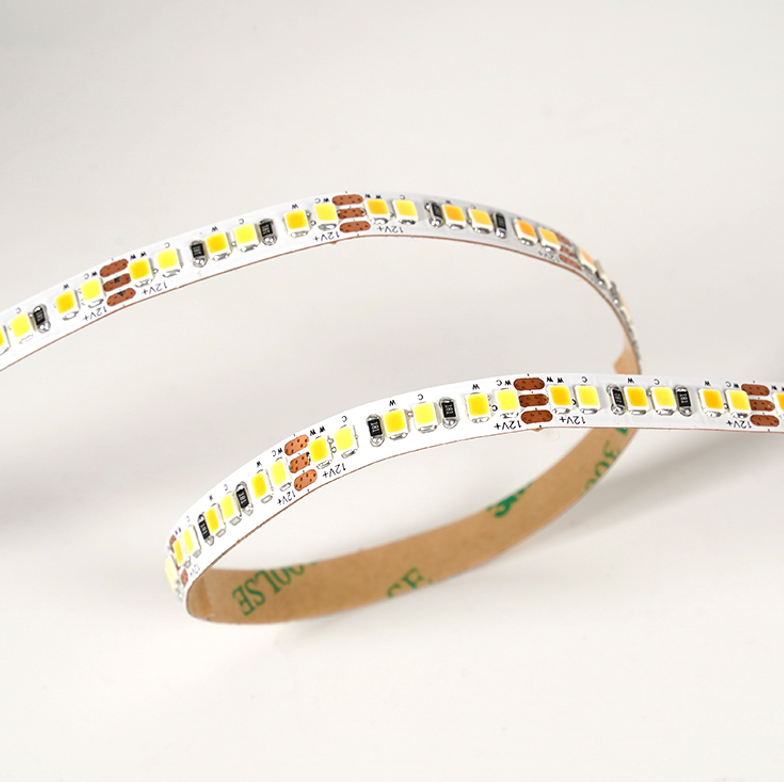
Stock silicone sleeves for LED strips come in a few fixed widths, like 8mm, 10mm, and 12mm. The trouble is that real strips, especially dense COB or side emitting types, rarely match those numbers once the PCB tolerance, component height, and adhesive tape are accounted for. A loose sleeve wobbles inside an aluminum channel and produces uneven shadow lines. A tight one scrapes the strip during insertion, risking damage to the solder pads. Even a half millimeter discrepancy can turn a smooth linear glow into a visually distracting installation. That is why specifying a custom silicone LED strip tube is often a basic fitment requirement, not an upsell.
Silicone tube production uses continuous extrusion followed by heat curing. A precision die controls the internal cavity shape. For a custom run, the die is machined to match the exact strip width, height, and wall thickness that the project demands. Quality silicone extrusion routinely holds tolerances of plus or minus 0.1mm on critical surfaces. That level of control removes the slop that undermines IP rated seals. It also allows the outer profile to be shaped for a snap fit into a non standard housing. Unlike off the shelf parts that force compromises, a tailored extrusion aligns the inner and outer dimensions with both the strip and the fixture from the very start.
During a retrofit inside a fertilizer plant in southern China, the specification called for continuous LED lines inside existing aluminum channels originally machined for fluorescent fixtures. The internal groove measured 12.4mm wide and had a curved floor. Generic 12mm silicone sleeves sat loosely, leaving dark gaps along the edges that ruined the uniform look. The engineering team pulled precise cross section data and worked with a silicone extruder to produce tubes with a 12.5mm inner width and a contoured base. The resulting friction fit held the strip securely without any adhesive and maintained an IP65 seal per IEC 60529 against ammonia rich humidity. Over 300 meters of linear light, zero failures were recorded in six months. That kind of reliability does not come from luck; it comes from dimensional customization.
Not all silicone compounds perform the same way under sustained load. Shore A hardness for LED strip sleeves generally falls between 50 and 70. Softer material around 50A feels pliable and seals easily, yet it can deform under heat when the wall is too thin. Harder compounds above 65A hold their shape better but require a gentler bending radius. Light transmission matters equally. A well formulated translucent silicone passes 88 to 92 percent of visible light with minimal chromatic shift, while adding soft diffusion that masks individual LED dots. For outdoor or sun exposed runs, UV endurance moves to the top of the checklist. Silicone inherently resists UV degradation better than polycarbonate or PVC, but quality varies. UV stabilizers and platinum cured systems push service life further. Platinum cured formulations also leave fewer volatile residues, a detail that matters in sealed fixtures where outgassing can fog optics. Requesting ASTM G154 accelerated weathering data provides a factual baseline instead of marketing claims.
When protecting linear LED strips, three main options appear: extruded silicone tubes, rigid polycarbonate covers, or potting compounds. The table below lines up key traits drawn from field measurements and supplier datasheets. The IP ratings referenced align with IEC 60529 methodology.
| Characteristic | Silicone Tube | Rigid PC Cover | Potting Compound |
| Typical visible light transmission | 88 to 92% | 80 to 85% | 85 to 90% |
| Flexibility and bending radius | Tight, under 30mm possible | Minimal, straight runs only | Depends on cured hardness |
| IP rated sealing | Excellent, uniform compression | Good with gaskets | Excellent, fully encapsulates |
| Replacement or rework difficulty | Low, strip can be pulled out | Medium, snap fit clips | High, permanent bond |
| UV stability without coating | Superior, inherent | Needs co-extruded UV layer | Varies, can chalk |
| Installed cost per meter (relative) | Medium | Low to medium | High |
The figures show silicone tubes sitting in a useful middle ground. They deliver optical clarity, consistent sealing, and reworkability that rigid covers and potting cannot offer at once. The flexibility also lets a single custom silicone LED strip tube design follow curved architectural details without extra lenses or diffusers.
Custom silicone tubes solve dimensional problems elegantly, but they are not a universal fix. Tooling a dedicated die costs a few hundred dollars, so very short runs of just a few meters become disproportionately expensive. For small residential DIY projects, a carefully chosen stock sleeve with a snug fit often does the job. Very long continuous lengths, say beyond 50 meters in one piece, stretch extrusion capabilities. Silicone tubing comes in finite coils, and joining sections always introduces a seam that can compromise the IP integrity at the splice. For most linear projects between 10 and 100 meters, the tooling cost amortizes quickly and makes solid economic sense. Applications that demand high impact resistance may also benefit from a rigid secondary housing instead of relying solely on a soft silicone envelope. Knowing these boundaries prevents overengineering and keeps project budgets realistic.
For commercial and architectural jobs that require a precise, long lasting fit, sourcing dimensionally accurate silicone tubes from a manufacturer with dedicated extrusion control cuts down on site rework and callbacks. Lightwolf, operating its own production facility in Guangdong since 2013 with a 70 person team focused on LED profiles and strip lighting, brings that kind of manufacturing discipline to custom silicone LED strip tube orders. In house tooling, tight tolerance verification, and a fast sampling loop help international projects stay on schedule without sacrificing sealing performance. That vertical integration streamlines the supply chain and removes the back and forth that often delays custom orders from pure trading companies.

 EN
EN