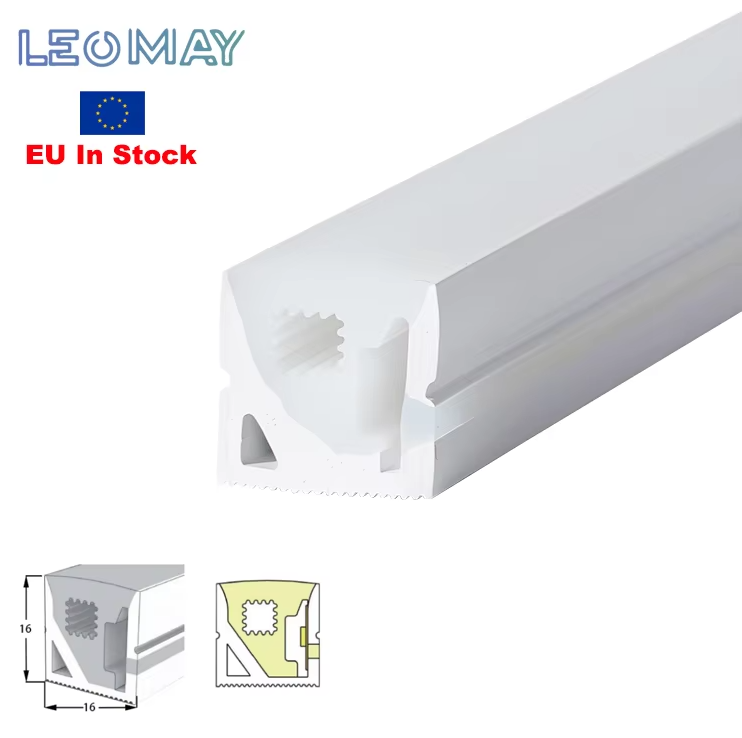
RGB LED strips look spectacular on a demo reel. Saturated reds, deep blues, vivid greens. Then they go into a standard diffuser and something gets lost. The colors flatten, the edges bleed, and what was supposed to be a crisp magenta looks more like a tired pink. The culprit is rarely the diodes themselves. More often, the silicone tube for LED strip protection is the weakest link in the optical chain. Low grade silicone scatters certain wavelengths more aggressively than others. Blues and cool whites survive reasonably well because they carry higher energy. Reds and ambers, sitting at longer wavelengths, get absorbed and diffused into mush. A tube that measures fine on a light meter under white light can still ruin an RGB installation.
Silicone is not just silicone. The base polymer, the curing system, and any fillers added during compounding all tweak the refractive index and spectral transmission curve. Platinum cured optical grade silicone delivers the flattest transmission across the visible spectrum, typically 400 to 700 nanometers. Peroxide cured alternatives often introduce a slight yellowish cast right out of the die, and that cast deepens with thermal aging. Fillers make things worse. Some manufacturers add fumed silica to boost tear strength, but at a cost. Every fraction of a percent of filler scatters light, and that scattering hits the red end of the spectrum hardest. For an RGB silicone tube that needs to preserve color fidelity from deep red at 630 nanometers up through blue at 470 nanometers, filler content and cure chemistry are not esoteric details. They are the spec.
A mid sized nightclub in Bangkok specified 180 meters of RGB strip for a ceiling cove that wrapped around the main dance floor. The design called for slow color fades across the spectrum, synced to the audio system. During the mockup phase, the installer used a generic silicone sleeve pulled from local stock. Under deep blue and violet presets, the cove looked acceptable. Switch to warm amber or full red, and the output dropped nearly 35 percent compared to bare strip measurements. The silicone was absorbing the longer wavelengths. The project team sourced a platinum cured, low filler silicone tube for LED strip applications with a documented spectral transmission chart. After swapping the sleeves, the measured color shift across the full RGB palette stayed under a Delta E of 3, per CIE 1976 standards. The ceiling cove delivered the intended immersive effect without dead zones or muddy transitions.
There is a persistent belief that heavy diffusion makes RGB strips look better. It does not, at least not for direct view applications. Heavy diffusion turns distinct colors into a milky pastel wash. What RGB strips actually need is high clarity tubing with just enough surface texture to break up individual diode hotspots without stealing saturation. Think of it as clarity first, diffusion second. A silicone tube with 88 to 92 percent transmission and a micro textured inner wall strikes that balance. The micro texture scatters light at very shallow angles, softening the dotted line effect, while the bulk material stays transparent enough to let the native color through. The table below compares three common sleeve approaches for RGB strips, based on field measurements and supplier optical data.
| Sleeve Type | Color Saturation Preservation | Hotspot Masking | Typical Transmission (400-700nm) |
| Clear, high clarity silicone | Excellent | Poor | 90 to 92% |
| Heavy milky diffusion | Poor, colors wash out | Excellent | 70 to 78% |
| Micro textured, high transmission | Very good | Good | 88 to 90% |
The micro textured option consistently lands in the sweet spot. It hides the dots without killing the color. For architectural RGB lines that run at full brightness, this is the difference between a professional look and something that reads as a budget installation.
RGB strips run hot, especially when all three channels fire at once to produce white or pastel mixes. That heat sits trapped inside the profile, baking the silicone tube from the inside out. Thermal yellowing is a known failure mode. The tube slowly shifts from water clear to pale amber, and as it does, it acts as a blue filter. Suddenly the calibrated RGB mixes drift. Cool white presets turn warm. Magentas lean red. UV exposure from outdoor or window adjacent installations accelerates the same degradation from the outside. The fix starts with material selection. Platinum cured silicone with thermal stabilizers rated for continuous 150 degrees Celsius service buys years of color stability. Peroxide cured, unfilled silicone in the same hot environment can show visible yellowing within 12 to 18 months. For outdoor RGB facades, UV absorbers in the silicone formulation become non negotiable. The added cost per meter is small compared to the labor of re pulling hundreds of meters of strip through sleeving on a finished building.
There is no need to overspec every project. For short indoor accent runs where the strip operates at 50 percent brightness or less, a good quality standard silicone tube for LED strip protection works perfectly. The thermal load stays low, UV is absent, and slight color shifts are hard to notice against a busy visual background. Residential under cabinet lighting, toe kick accents, or cove lights in a home theater rarely push the limits. The premium optical grade tubes earn their keep on commercial jobs with long duty cycles, high brightness demands, or precise brand color matching. A retail display that must render a corporate logo in exact Pantone matched light, for instance, cannot tolerate a sleeve that nudges the white point. Knowing where to draw the line between standard and high fidelity tubing keeps budgets lean without sacrificing performance where it counts.
For projects that depend on accurate, punchy RGB color from end to end, working with a supplier that understands the optical side of silicone extrusion makes a measurable difference. Lightwolf, with its own production facility in Guangdong operating since 2013 and a 70 person team dedicated to LED profiles and strip lighting, approaches custom silicone tube for LED strip orders with attention to transmission, cure chemistry, and dimensional fit. In house tooling and batch level optical verification help ensure that the tube protecting the strip is not also the thing holding back the color.

 EN
EN