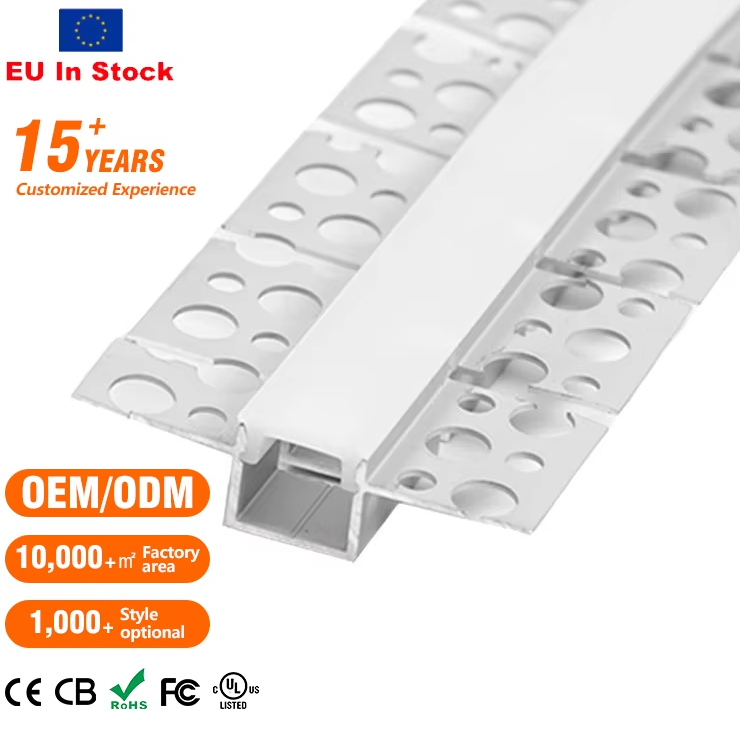
Standard aluminum profiles are mass-produced with generic dimensions that rarely match the exact specifications of professional LED strips. Tolerances in off-the-shelf channels often exceed ±0.5mm—small but critical misalignments that undermine performance. When an LED strip sits even slightly off-center, light passes unevenly through the diffuser, producing visible hotspots and shadows. Mounting brackets on these profiles are equally imprecise, leading to wobble or gaps that compromise clean, straight installation lines. Over time, thermal expansion can widen these gaps, causing sagging or detachment. In contrast, custom aluminum profiles maintain a ±0.1mm tolerance, ensuring the LED strip seats flush and the diffuser clips tightly over the full length—eliminating light leaks and delivering the uniform linear glow architects require. Field data from a 2023 installation survey by the Illuminating Engineering Society found that 42% of callback requests for linear LED projects stemmed from uneven diffusion caused by ill-fitting standard profiles.
Thermal management remains the most underestimated failure point in LED systems. An undersized aluminum profile lacks the mass and surface area needed to efficiently pull heat away from diodes. Industry research confirms that insufficient heat dissipation can cut LED lifespan by up to 50%, while also triggering color shift and lumen depreciation (Illuminating Engineering Society, 2022). Profiles with wall thickness below 1.5mm or minimal fin geometry often fail to provide an adequate thermal pathway, allowing junction temperatures to exceed 85°C—the threshold where accelerated degradation begins. Conversely, oversized profiles add unnecessary weight and structural load, requiring more robust mounting hardware and increasing material cost by 15–20% without meaningful thermal benefit. Worse, excessive size can create poor physical contact between the LED strip and channel base, introducing insulating air gaps instead of conductive pathways. Custom design resolves this by aligning thermal mass precisely with LED wattage—balancing effective heat dissipation with structural economy.
Custom aluminum profiles manufactured to ±0.1mm tolerance transform LED lighting performance in ways standard extrusions cannot. For thermal management, full-contact attachment between the LED strip and channel base is non-negotiable. Even a 0.2mm air gap reduces heat transfer efficiency by more than 30%, pushing junction temperatures beyond safe limits and shortening diode lifespan (industry thermal interface studies, 2023). Precision-machined mounting grooves and flat bases guarantee uninterrupted metal-to-metal contact—so heat moves directly into the profile and dissipates through its fins. On the optical side, diffuser alignment is equally unforgiving: a 0.15mm deviation in the clip-in slot causes the plastic diffuser to sit unevenly, creating bright spots and dark gaps that disrupt uniform light distribution. With ±0.1mm control, each diffuser locks into the exact plane of the LED board across the entire length—preserving beam angle, eliminating stray light, and enabling consistent snap-fit assembly. The result is a luminaire that maintains photometric performance and thermal stability from day one through years of continuous operation.
A recent architectural lighting installation on a sweeping glass facade demonstrates the practical value of dimensional precision. The design called for a continuous, 12.7-meter run of linear LED grazing fixtures integrated into the building’s curved mullions. Off-the-shelf aluminum profiles proved unusable—their fixed radii and ±1mm tolerances left visible joint gaps and misaligned diffusers at every bend. A custom solution was engineered with variable curvature matching the facade’s exact arc, and every mounting surface machined to ±0.1mm. The result was a seam-free channel accepting the LED strip and opal diffuser in a single pass—no field cutting, shimming, or rework required. On-site installation time dropped by 34% compared to the previous project using standard extrusions (contractor installation log, 2024). Thermal camera surveys confirmed even heat spread along the entire 12.7-meter length, with no hot spots at bend transitions. Uniform luminance met the architect’s specification of ≤5% variation—and the slim-profile aluminum channel became an integrated design element rather than an afterthought, proving that tight tolerance control enables both aesthetic continuity and long-term reliability.
Custom aluminum profiles reduce on-site adjustments by 34% compared to standard channels—a finding validated by a 2023 field analysis conducted by a leading lighting design firm. This labor saving stems from precise dimensional matching to LED strip specifications, eliminating time-consuming cutting, filing, or shimming that typically accounts for 20–30% of installation hours. Pre-drilled mounting holes and snap-fit diffuser retention systems accelerate assembly, while integrated wiring channels and pre-installed connectors simplify electrical work—cutting wiring time nearly in half and removing the need for separate junction boxes. The lightweight nature of aluminum also eases handling, reducing fatigue and minimizing errors that trigger costly rework. For commercial projects spanning hundreds of meters, this efficiency translates directly into lower labor costs and faster project completion. By engineering profiles to exact installation requirements—including end caps, mounting brackets, and wiring channels—contractors avoid hidden field-modification costs. Because the profiles arrive ready to mount, general laborers—not just skilled electricians—can handle installation, compressing labor budgets without compromising quality. Ultimately, purpose-built aluminum profiles deliver a plug-and-play solution that protects profit margins while maintaining lighting performance.
Q: Why do standard aluminum profiles cause issues in LED installations?
A: Standard profiles often feature loose tolerances exceeding ±0.5mm, leading to uneven light diffusion, gaps in mounting stability, and thermal management inefficiencies.
Q: How do custom aluminum profiles improve thermal management?
A: Custom profiles provide full-contact attachment between LED strips and channel bases, ensuring efficient heat transfer and extended diode lifespan.
Q: Can custom profiles save on installation labor costs?
A: Yes, precise dimensional matching and pre-drilled design elements reduce field adjustments, cutting down labor costs by up to 34%.
Q: Are custom aluminum profiles better suited for large architectural projects?
A: Indeed, they allow for exact matching to unique design curves, as seen in projects like the 12.7-meter curved facade run, delivering seamless integration and reducing installation time.
 EN
EN