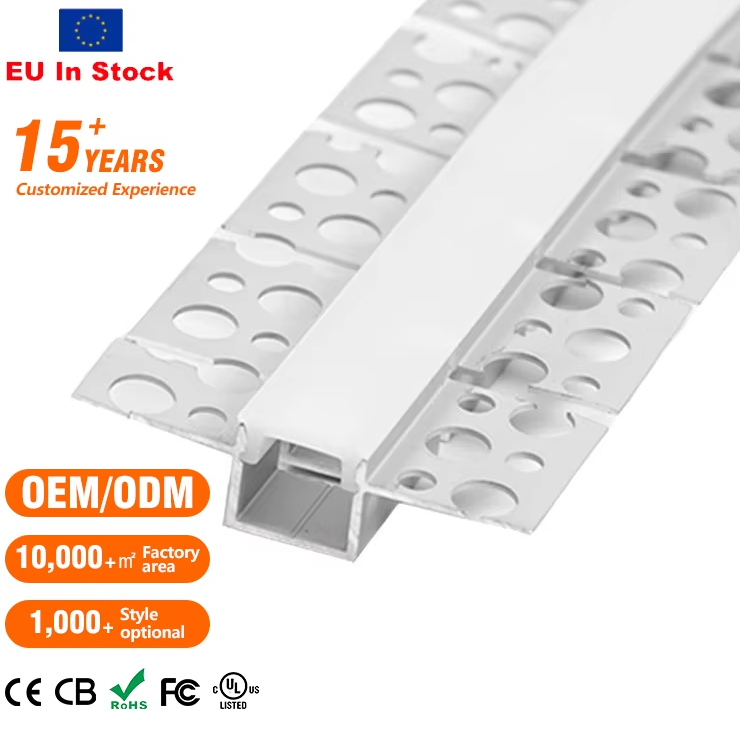
Aluminum profiles serve as critical heat sinks in LED commercial lighting, efficiently dissipating thermal energy to prevent premature component failure. Since LEDs convert only about 30% of input energy into light—the remainder becomes heat—effective thermal management is non-negotiable for performance and longevity. Aluminum’s thermal conductivity (~200 W/m·K) far exceeds that of plastic (0.2 W/m·K) and steel (50 W/m·K), enabling rapid heat transfer away from sensitive LED chips. High-performance heat sink profiles leverage optimized fin geometry to increase surface area for convection cooling, lowering junction temperatures by up to 15 °C compared to passive plastic enclosures. According to the Arrhenius equation, each 10 °C reduction in operating temperature can double LED lifespan—making this thermal advantage directly proportional to system reliability. Steel’s weight and corrosion susceptibility, coupled with plastic’s insulating properties, accelerate lumen depreciation and color shift. By integrating aluminum profiles, lighting designers ensure stable light output, extended service intervals, and reduced total cost of ownership across retail, office, and industrial environments.
The 6063 aluminum alloy stands out for its ideal balance of magnesium and silicon, delivering inherent corrosion resistance and exceptional readiness for anodizing—key attributes for long-term performance in commercial lighting. Its natural oxide layer provides robust protection against oxidation, especially in humid or coastal settings where ferrous materials degrade rapidly. Anodizing transforms the surface into a durable, translucent aluminum oxide layer with hardness exceeding 300 Vickers and outstanding UV stability—critical for exterior luminaires exposed to sunlight or intense artificial lighting. Per ASTM B117 salt spray testing, properly anodized 6063 profiles withstand 1,500 hours without pitting, confirming decades of structural and aesthetic integrity. The process also enables a wide range of consistent, fade-resistant finishes—from matte silver to custom bronze—without compromising mechanical strength. Unlike painted or galvanized steel alternatives, which require periodic recoating and suffer from chipping or galvanic corrosion, 6063 aluminum offers a low-maintenance, future-proof solution aligned with architectural and sustainability goals.
| Rank | Profile Type | Fin Density (fins/inch) | Wall Thickness (mm) | Key Advantage |
|---|---|---|---|---|
| 1 | High-density extruded heat sink | 30–40 | 2.5 | Maximum heat dissipation for high‑output COB LEDs |
| 2 | Balanced fin/wall profile | 20–25 | 3.0 | Versatile thermal management with structural support |
| 3 | Thick‑wall, low‑fin profile | 15–20 | 4.0 | Superior mechanical integrity for heavy fixtures |
These profiles combine 6063 alloy’s high thermal conductivity (201 W/m·K) with precision extrusion to move heat efficiently from the LED junction to ambient air. A 35-fins-per-inch design, for example, lowers LED temperature by ~15 °C versus solid-block alternatives—directly extending luminaire life. Wall thicknesses above 2.5 mm ensure rigidity under load and resist deformation during thermal cycling or fixture assembly. Such engineering makes these profiles foundational to reliable, high-output lighting in demanding applications like warehouse high-bays and retail accent systems.
| Rank | Profile Type | Interlocking Mechanism | Integrated Wiring | Typical Application |
|---|---|---|---|---|
| 4 | 3‑circuit track with toolless interlock | Snap‑fit connectors | 2 × 1.5 mm² channels | Retail display lighting |
| 5 | Magnetic low‑voltage track | Magnetic alignment | Single continuous channel | Museum and gallery lighting |
| 6 | Universal track with adapter compatibility | T‑slot interlocking | 3 × 2.5 mm² channels | Commercial office lighting |
Engineered for speed and adaptability, these aluminum track systems cut installation time by up to 40% through toolless, snap-fit or magnetic interlocking. Integrated wiring channels eliminate external conduit runs, preserving clean sightlines and simplifying compliance with electrical codes. Built from 6063 alloy, they accept durable anodized finishes that resist corrosion in conditioned or humid interiors. Their reconfigurability supports evolving spatial needs—ideal for retail pop-ups, rotating gallery exhibits, or open-plan office re-zoning—while maintaining stable electrical contact across long linear runs.
| Rank | Profile Type | Surface Finish | UV‑Stable Anodized Coating | Typical Use |
|---|---|---|---|---|
| 7 | Recessed linear housing | Brushed aluminum | 20 µm, UV‑stable | Ceiling grid integration |
| 8 | Surface‑mount slim profile | Matte white powder coat | 15 µm anodized base, UV‑stable | Wall and ceiling mounted |
| 9 | Pendant linear profile | Clear anodized | 25 µm, UV‑stable | Suspended linear lighting |
| 10 | Corner‑mount triangular profile | Satin anodized | 18 µm, UV‑stable | Cove and accent lighting |
Architectural aluminum profiles prioritize visual continuity and enduring aesthetics. Tight extrusion tolerances ensure invisible joints and uninterrupted light lines—essential for high-end retail, hospitality, and corporate interiors. The UV-stable anodized coating prevents yellowing, maintains color fidelity, and resists scratching and environmental wear over time. Whether recessed into ceiling grids or suspended as sculptural elements, these profiles deliver both functional precision and design intention—preserving original specifications with minimal long-term maintenance.
Wall thickness is a decisive factor in aluminum profile performance—dictating both mechanical resilience and thermal behavior. For heat sink applications, walls between 1.0–1.5 mm allow higher fin density and greater surface area, optimizing convective cooling—but require precise extrusion control to avoid warping during thermal cycling. Structural housings and mounting frames demand minimum wall thicknesses of 1.5–2.0 mm to support LED modules, lenses, and hardware without deflection or fatigue. Uniform wall thickness across the cross-section ensures consistent anodizing quality, dimensional stability, and reliable thermal contact with PCBs or drivers. Profiles manufactured to ASTM B221 standards deliver tight tolerances (±0.1 mm), minimizing assembly gaps and maximizing heat transfer efficiency. Thoughtful wall-thickness optimization enables lightweight, cost-effective designs that sustain lumen output and structural integrity over years of commercial operation.
Matching aluminum profiles to application-specific demands ensures optimal performance, longevity, and aesthetic cohesion. Retail displays benefit from low-glare, surface-mounted linear housings that deliver uniform illumination while maintaining sleek visual continuity. Open-plan offices rely on recessed linear channels that integrate seamlessly into ceiling grids—supporting both architectural minimalism and efficient light distribution. In high-bay industrial settings, deep-fin, thick-wall heat sink profiles are essential to manage heat from high-wattage LED arrays and maintain safe junction temperatures during 24/7 operation.
Environmental exposure and installation method further refine selection. Covered parking structures, refrigerated storage, or semi-outdoor corridors require profiles with enhanced anodized coatings (≥20 µm), sealed end caps, and moisture-resistant gasketing. Where flexibility matters most—such as rotating art installations or seasonal retail layouts—modular track systems with integrated wiring offer reconfiguration without rewiring or downtime. Early collaboration with a qualified aluminum extruder or lighting component supplier helps translate functional and aesthetic requirements into precise alloy selection (6063-T5/T6), wall thickness, thermal design, and finish specification—reducing field adjustments, accelerating commissioning, and lowering lifetime maintenance costs.
Why are aluminum profiles preferred for commercial lighting?
Aluminum profiles are chosen for their high thermal conductivity, corrosion resistance, and versatility in design. They maximize LED longevity and are suitable for various architectural and industrial settings.
What is the significance of 6063 aluminum alloy in lighting applications?
6063 aluminum alloy is ideal due to its corrosion resistance and anodizing readiness, offering durable finishes and long-term reliability in challenging environments.
What are the top applications for aluminum profiles in lighting?
Applications include heat sink profiles for industrial LEDs, modular track systems for adaptable lighting, and architectural linear housings for seamless design aesthetics.
How does wall thickness influence aluminum profile performance?
Wall thickness affects both structural integrity and thermal efficiency. Profiles for heat dissipation need thinner walls, while support frames demand thicker walls for durability.
What maintenance is required for aluminum profiles?
Properly anodized profiles require minimal upkeep, as they resist corrosion, fading, and environmental damage over decades of use.
 EN
EN