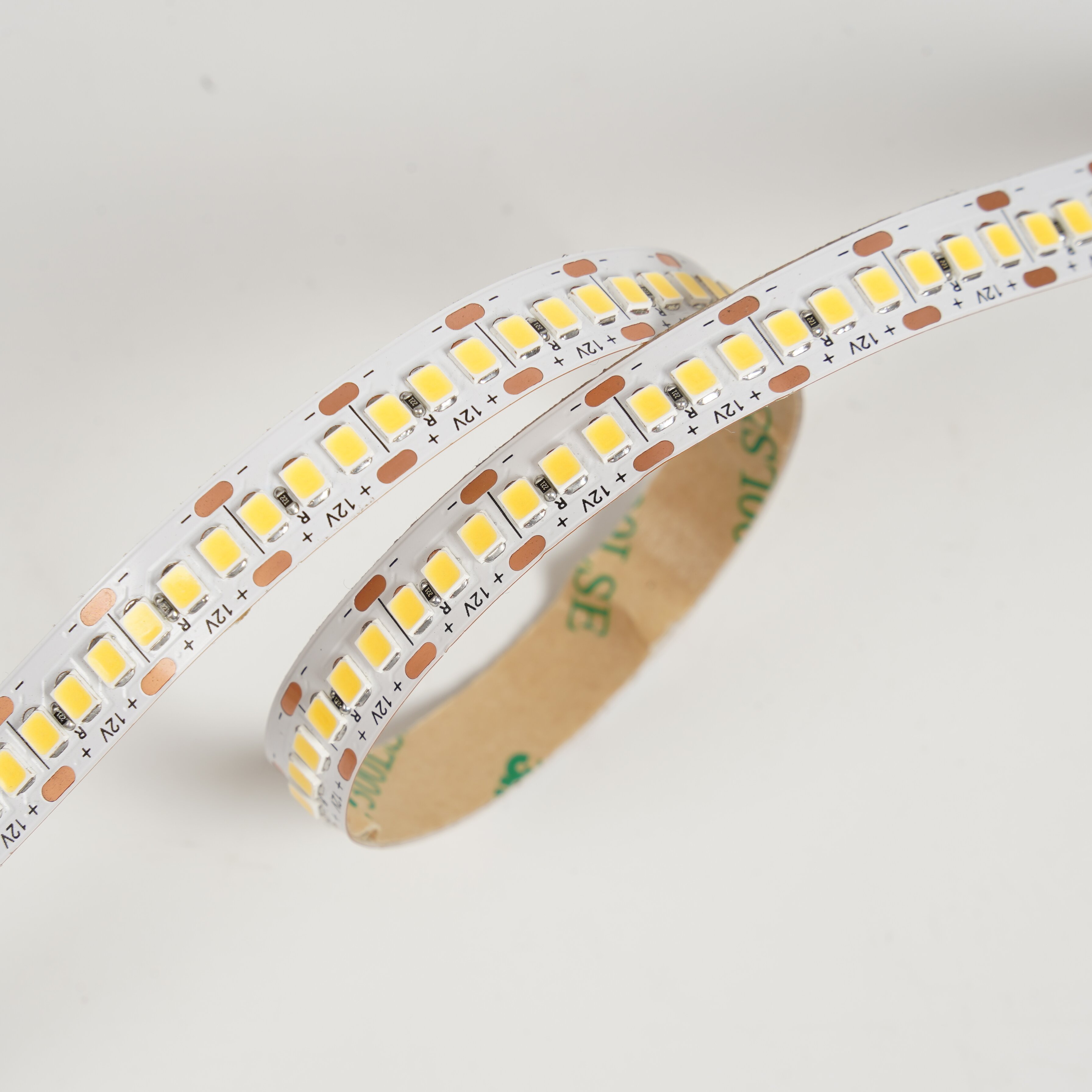
Higher-density LED strips eliminate dark spots between diodes, delivering seamless light output—essential for cove lighting, retail displays, and other applications where visual consistency is non-negotiable. At 120–180 LEDs per meter (LEDs/m), brightness reaches up to 1,500 lumens/meter, while the “dotting effect” drops by 70% compared to strips with fewer than 100 LEDs/m. COB (Chip-on-Board) technology enhances this further by integrating multiple chips into a single light-emitting surface, enabling smoother gradients—even around bends and corners.
Denser LED layouts increase thermal load and power draw. Strips with 120 LEDs/m typically consume 18–24W/m; those at 180 LEDs/m require 28–34W/m. Without adequate heat dissipation—such as aluminum extrusions or thermal pads—junction temperatures can rise 15–20°C above ambient, accelerating lumen depreciation. Yet high-density designs often pair efficient drivers with stable 24V DC systems to achieve 100–120 lm/W, exceeding Energy Star benchmarks for efficacy. The table below summarizes key thermal and power considerations:
| Density (LEDs/m) | Power Consumption (W/m) | Thermal Management Requirement |
|---|---|---|
| 120 | 18–24 | Moderate (passive cooling) |
| 180 | 28–34 | High (aluminum heatsink required) |
For focused illumination in kitchens, offices, and workshops, 120 LEDs/m strikes an optimal balance of precision, efficiency, and thermal control. This density delivers concentrated, shadow-free light on countertops and desks while minimizing heat buildup—enabling extended operation without thermal throttling. At the U.S. national average electricity rate of $0.12/kWh (U.S. EIA 2023), it supports 30–50% lower energy costs than traditional task lighting. Key use cases include:
The 180 LEDs/m density excels where uninterrupted light quality defines the experience—especially in indirect and contour-based applications. Its tight diode spacing eliminates visible gaps, producing smooth gradients ideal for ambient settings. Top applications include:
Because thermal stress is higher at this density, aluminum channels are strongly recommended—not only for heat dissipation but also to preserve the rated 50,000+ hour lifespan. Flexible PCBs in premium strips retain circuit integrity through repeated bending, supporting complex installations without performance loss.
A 3–5 year warranty signals more than marketing confidence—it reflects validated engineering rigor. Industry data shows that LED strips backed by warranties exceeding three years consistently demonstrate MTBF (Mean Time Between Failures) rates above 50,000 hours (Luminous Efficacy Journal 2023). This correlation arises from accelerated life testing—including thermal cycling and humidity exposure—applied specifically to high-density configurations (120–180 LEDs/m). Real-world failure analysis confirms that products with sub-3-year coverage suffer 2.3× more early lumen depreciation (>15% brightness loss) than their 5-year warrantied counterparts. Extended coverage directly reflects confidence in solder joint integrity, chip binning consistency, and overall build resilience—reducing long-term replacement costs and ensuring project longevity.
Three interdependent engineering factors determine real-world reliability:
Together, these design choices reduce annual field failure rates to under 1.2% in 5-year warrantied strips—versus 4.7% in budget-tier alternatives.
LED strip density refers to the number of LEDs per meter on a strip. Higher densities (120–180 LEDs/m) provide brighter, more uniform illumination and reduce visual inconsistencies like dark spots, making them ideal for professional applications.
Higher-density strips typically draw more power due to the increased number of LEDs. For example, 120 LEDs/m strips consume 18–24W/m, while 180 LEDs/m strips require 28–34W/m.
Heat dissipation is crucial for high-density strips. Aluminum channels, thermal pads, or passive cooling systems can help prevent excessive junction temperatures and maintain performance longevity.
For task lighting, 120 LEDs/m offer focused, efficient lighting suited for kitchens and workspaces. For ambient or architectural lighting, 180 LEDs/m ensure smooth, continuous brightness without visible gaps.
Choose products with extended warranties (3–5 years) and features such as thick-copper PCBs, moisture-resistant FR-4 substrates, and stable DC drivers to enhance durability and minimize failure rates.
 EN
EN