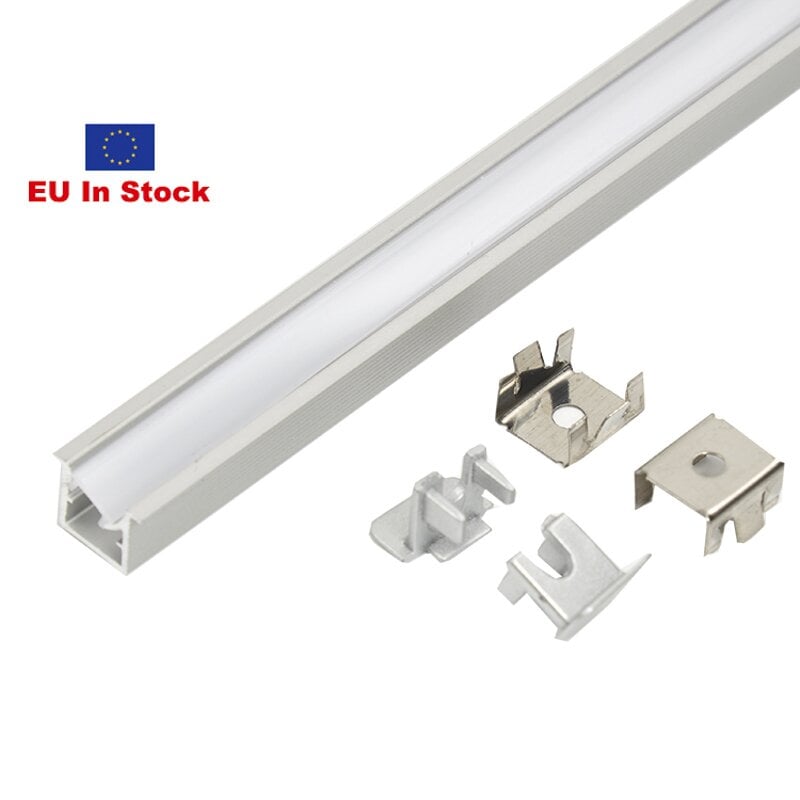
Underwriters Laboratories (UL) certification is not a marketing badge—it’s a non-negotiable safety benchmark. While UL Recognition applies only to individual components (e.g., drivers or LEDs), UL Listing evaluates the complete, assembled system, including aluminum profiles, wiring, thermal interfaces, and mounting hardware. For LED profile light systems, this holistic validation confirms the integrated assembly won’t overheat, short-circuit, or ignite under real-world load conditions. Component-level recognition leaves critical gaps—such as unverified thermal coupling between LEDs and extrusions—that can trigger thermal runaway. UL Listed systems undergo more than 20 destructive and stress tests, including abnormal operation simulations, insulation resistance checks, and dielectric withstand at 6,000V. Because of this rigor, major building codes—including the International Building Code (IBC) and NFPA 70 (NEC)—explicitly require full UL Listing for permanently installed luminaires.
The National Electrical Code (NEC) Article 410 sets enforceable safety standards for all luminaires—and UL certification is the most widely accepted path to compliance. UL’s testing methodology directly validates the requirements in three foundational areas:
| Safety Aspect | UL Verification Method | NEC 410 Compliance Link |
|---|---|---|
| Overcurrent Protection | Short-circuit current testing | Sec. 410.58 |
| Thermal Management | Temperature cycling tests | Sec. 410.4 |
| Wiring Integrity | Strain relief and pull-test evaluations | Sec. 410.24 |
This alignment prevents life-threatening failures—such as energized aluminum profiles during ground faults—by verifying robust grounding, fault-current handling, and mechanical protection. According to the Ponemon Institute (2023), arc-flash incidents in non-compliant lighting installations cost an average of $740,000 per event. In commercial retrofits, UL Listing accelerates AHJ (Authority Having Jurisdiction) approval by eliminating field verification delays. For residential use—especially in tight, thermally constrained spaces like coves or under-cabinet runs—UL-certified systems provide proven protection against fire ignition and driver thermal failure.
Thermal management is the single largest determinant of LED system longevity—and Lightwolf’s extruded aluminum profiles are engineered as active heat sinks, not passive housings. Leveraging aluminum’s high thermal conductivity (237 W/m·K), these profiles dissipate heat up to five times faster than plastic or silicone alternatives. This keeps LED junction temperatures consistently below 85°C—the critical threshold identified in IES LM-80 testing, where every 10°C reduction doubles rated lifespan. As a result, Lightwolf systems maintain ≥95% luminous flux after 50,000 hours and reduce driver failure rates by 30% compared to non-heat-sinked installations. Strategically placed extruded fins increase surface area by 40%, enhancing convection cooling even in low-airflow applications like recessed coves and enclosed cabinets.
Lightwolf’s anodization process forms a dense, micro-crystalline aluminum oxide layer—25 µm thick—that transforms the base metal’s performance. This electrochemically sealed barrier delivers three essential advantages:
The oxide layer bonds molecularly to the substrate, surviving extreme thermal cycling from –40°C to +120°C without cracking, flaking, or oxidation. Combined with aluminum’s inherent strength-to-weight ratio (69 GPa Young’s modulus), Lightwolf profiles retain dimensional stability under sustained loads of 150 N/m—meeting seismic and vibration-resistance requirements in demanding applications. This foundation supports a verified 20+ year service life while preserving optical clarity and diffuser adhesion.
UL certification establishes baseline electrical and fire safety—but real-world reliability demands layered validation. Three additional metrics define true system resilience:
Together, these validations satisfy NEC 410.130’s mechanical protection mandate—and address failure modes UL alone doesn’t cover, ensuring long-term performance where it matters most: behind walls, above ceilings, and in exposed outdoor settings.
Outdoor LED profile light systems face compounding stressors—moisture infiltration, UV-induced material breakdown, and wide thermal swings—all of which accelerate failure if unmitigated. UL 2108 certification specifically validates luminaires designed for wet and damp locations, requiring successful completion of 1,000-hour salt-spray and UV-aging tests, plus thermal cycling from –40°C to +85°C. Lightwolf’s UL 2108–listed profiles meet NEC 410.158 by combining IP65-rated silicone gaskets with fully anodized aluminum construction that blocks UV penetration while enabling rapid heat dissipation. This dual function preserves both optical clarity and lumen output—addressing thermal stress and photodegradation, the two leading causes of outdoor LED failure. Electrical safety audits (2023) show non-UL-listed outdoor installations suffer 65% higher failure rates within three years—underscoring that compliance isn’t theoretical. It’s the difference between decades of dependable illumination and costly, hazardous early replacement.
UL Listing evaluates the entire assembled system, including all components working together safely, while UL Recognition is specific to individual components like drivers or LEDs.
UL certification ensures safety, compliance with building codes, and long-term reliability by testing systems against overheating, short-circuiting, and fire risks.
UL testing ensures compliance with NEC Article 410 standards for overcurrent protection, thermal management, and wiring integrity.
The anodized aluminum provides resistance to corrosion, extreme temperatures, and abrasion while offering superior rigidity, flame resistance, and long-term durability.
Ingress Protection (IP65 or higher), UL flame-spread certifications, and environmental testing for UV, thermal cycling, and humidity enhance reliability beyond UL certification.
 EN
EN