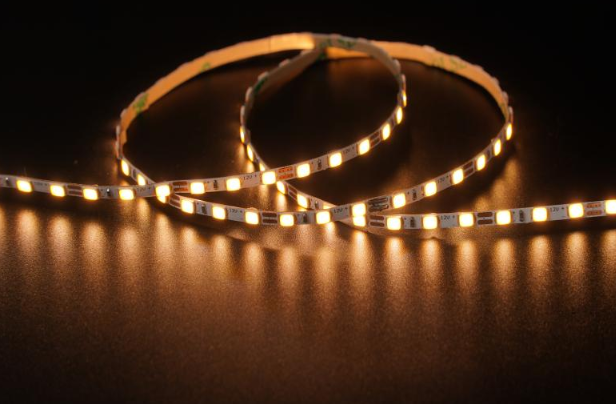
Lighting is no longer just about brightness. Color temperature and hue directly shape how a space feels, and RGB silicone LED strips give designers and homeowners the ability to paint with light. An RGB strip contains red, green, and blue diodes on the same circuit, and by varying the intensity of each channel, the strip can produce millions of distinct colors. The transition from static white lighting to full spectrum color opens up possibilities that were once expensive and complex. A restaurant can shift from cool daylight during lunch service to warm amber in the evening, and a retail window can cycle through brand colors without changing a single physical element. The technical foundation is additive color mixing, a principle standardized in the CIE 1931 color space that the lighting industry uses to define chromaticity coordinates. When the three primary colors blend smoothly inside a silicone body, the light appears as a uniform wash rather than separate dots, an effect that depends heavily on the quality of the encapsulation material.
The optical and mechanical properties of the encapsulation material determine how an RGB strip performs over time. Epoxy coatings and PVC sleeves can yellow under UV exposure, which shifts the perceived color temperature and dulls the saturation of mixed colors. A blue channel that dims faster than the red channel throws off the entire color balance. Silicone, by its chemical nature, resists UV degradation far longer. Its molecular backbone of alternating silicon and oxygen atoms does not absorb ultraviolet radiation the way carbon based polymers do. This means a silicone encapsulated RGB strip maintains its original color calibration through years of use, even near windows or in outdoor coves. From a protection standpoint, the solid silicone body also prevents moisture and airborne contaminants from reaching the LED chips and the solder joints. The International Electrotechnical Commission standard IEC 60529 defines ingress protection ratings, and a fully molded silicone strip can achieve IP67 or IP68 because there are no internal cavities. For a spa, a pool deck, or a bathroom feature wall, that level of sealing is the difference between a lighting installation that lasts and one that corrodes from the inside out within months.
One of the strongest arguments for RGB silicone strips is their physical adaptability. A rigid aluminum channel can only follow straight lines or factory bent curves. A silicone strip, depending on its cross section, can bend in multiple planes, twist, and conform to irregular architectural details. Installers working on curved reception desks, domed ceilings, or spiral staircases consistently find that silicone strips follow the structure without lifting at the edges or creating uneven light lines. The material also accepts field cutting between marked intervals, and the cut end can be resealed with a simple process that maintains the waterproof rating. This field adaptability reduces the need for custom factory bent profiles for every unique radius. The strip can be mounted in a shallow routed groove, tucked behind a cove lip, or surface mounted with low profile clips. The absence of a separate diffuser keeps the profile extremely compact, often under a few millimeters thick, which allows the lighting to disappear into the architecture when not in use and emerge as a vivid color line when illuminated.
The most vibrant RGB strip is only as good as the controller driving it. Modern RGB silicone strips operate with either analog voltage dimming per channel or with individually addressable IC chips that assign a data signal to each LED segment. The choice between the two depends on the design intent. Analog RGB control is well suited for uniform color washes across long runs, while addressable digital strips create animated chasing, flowing, and gradient effects that transform a wall or ceiling into a dynamic surface. Both methods rely on pulse width modulation to vary perceived brightness without shifting the diode's inherent color point. Handheld RF remotes, wall mounted touch panels, and smartphone apps over Wi Fi or Bluetooth now give users scene recall, scheduling, and music synchronization without needing a dedicated lighting console. Industry alliance standards like the Zigbee protocol or DALI ensure that the LED driver and controller communicate reliably across different manufacturers, which allows an RGB silicone strip installation to integrate smoothly into a larger building automation system.
In retail and hospitality, color is a strategic tool. Research on environmental psychology consistently finds that warm light increases dwell time in restaurants and lounges, while cooler, more saturated colors enhance the perception of cleanliness in wellness and medical settings. RGB silicone strips allow a single venue to serve multiple functions. A hotel lobby can greet early morning guests with a gentle sunrise simulation, shift to a vibrant accent for an evening event, and return to a dimmed safety glow overnight. Bar and nightclub designers use RGB strips to synchronize the entire perimeter of a room with the beat of the music, creating an immersive environment that static lighting cannot achieve. The durability of silicone makes these installations feasible in areas with high humidity, temperature swings, or physical contact, conditions that would quickly degrade less robust materials. Real estate developers and shopfitting contractors increasingly treat tunable colored lighting as a value add that differentiates their properties in a competitive leasing market.
Delivering repeatable, accurate color across multiple production batches requires tight process control. Lightwolf operates a dedicated silicone LED manufacturing facility where each RGB strip is tested for color consistency, channel balance, and waterproof integrity before shipment. The company sources high purity silicone and flexible PCB substrates from qualified material partners, and its engineering team works directly with project designers to configure strip lengths, connector types, and control compatibility for specific installations. By owning the extrusion, SMT placement, and final inspection steps, Lightwolf maintains predictable lead times and stable quality across standard and custom orders. Stocked RGB product lines cover the most widely specified voltages, color temperatures, and IP ratings. Custom configurations, including specific LED chip densities and side emitting profiles, ship within short lead windows. For electrical contractors, lighting distributors, and commercial interior designers, having a dependable source of certified RGB silicone LED strips that arrive ready to install simplifies procurement and keeps projects on schedule, from residential accent lighting to large scale hospitality fit outs.

 EN
EN