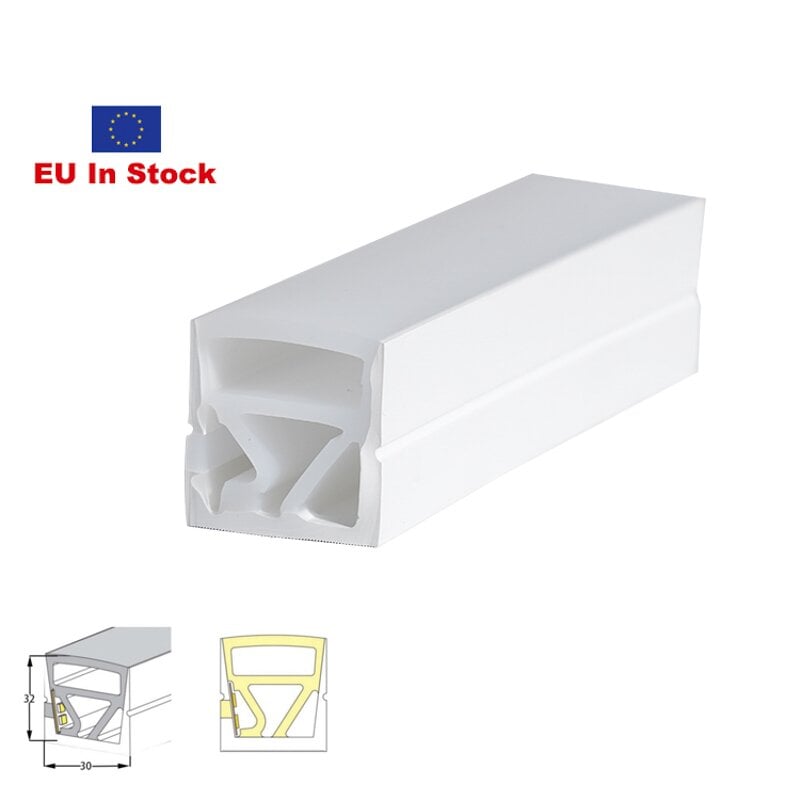
Light diffusion transforms harsh LED emissions into uniform illumination, reducing glare by 40–60% compared to bare LEDs (Illuminating Engineering Society 2023). This scattering effect enhances visual comfort in workspaces and living areas while preserving 85–92% of the original lumen output, making diffused lighting both efficient and user-friendly.
Clear silicone tubes transmit 92–95% of light with minimal refraction, producing a focused beam. In contrast, opaque variants use embedded microparticles to scatter photons across a wide 120–160° angle. This structural difference defines their distinct applications:
| Property | Clear Silicone | Opaque Silicone |
|---|---|---|
| Light Transmittance | 93% | 68% |
| Diffusion Angle | 15° | 140° |
| Perceived Brightness | High contrast | Uniform |
The choice between materials hinges on whether brightness or softness is prioritized.
According to Hospitality Design Magazine from last year, around three quarters of lighting pros working on hotels and homes go with frosted silicone tubes when setting the scene. These tubes really cut down on those annoying bright spots from LEDs, sometimes by as much as 90%. That means no harsh glare just nice even lighting across spaces. Most manufacturers offer color temperatures ranging between warm yellows at 2700K all the way up to crisp whites at 4000K. Warm lighting creates cozy atmospheres perfect for bedrooms or lounges where people want to unwind. Cooler options work great in contemporary bathrooms or kitchens where clean lines and sharp illumination matter most.
Commercial spaces typically aim for 70–80% diffusion to ensure eye comfort during prolonged exposure. Architectural installations often blend clear and opaque segments—a technique pioneered by leading manufacturers—to highlight structural features while providing even ambient fill. This hybrid approach balances aesthetic precision with visual well-being.
Transparent silicone LED tubes actually put out around 30 percent more light compared to their opaque counterparts, hitting impressive levels of up to 150 lumens per watt according to some recent testing from the Neon Materials folks in 2024. Because they transmit so much light through, these clear tubes work great in places like store windows and factory floors where getting the most illumination possible matters a lot. Now, frosted silicone isn't quite as bright, falling somewhere between 25 to 40 percent behind in efficiency terms, but what it lacks in raw output it makes up for in how evenly it spreads the light around. That's why many office spaces and museum galleries prefer this version since it creates fewer harsh shadows and generally feels more comfortable on the eyes during long periods of exposure.
The optical clarity of clear silicone stems from its 1.41 refractive index, which limits internal scattering. Opaque tubes feature micro-textured surfaces (refractive index: 1.38) that diffuse light effectively but reduce raw output. Key differences are summarized below:
| Property | Clear Silicone | Frosted Silicone |
|---|---|---|
| Refractive Index | 1.41 ±0.02 | 1.38 ±0.03 |
| Surface Texture | Smooth | Micro-roughened |
| Lumen Transmission | 92–96% | 55–68% |
| Diffusion Pattern | Directional beam | 140° wide dispersion |
Material selection directly influences both performance and design intent.
In 2023, research consortiums developed nano-structured silicone surfaces that cut internal reflections by 18%, achieving 93% optical clarity. These formulations retain flexibility and resist UV-induced clouding—addressing a major weakness in outdoor neon signage. Hybrid designs now integrate light-redirecting particles to enhance efficacy without compromising translucency, offering brighter, longer-lasting solutions.
Engineers have found ways to tackle those annoying bright spots in clear tubes by using these special micro-prism lenses. These little optical tricks actually manage to take about 22 percent of the central light intensity and spread it out towards the darker areas. Some real world testing in warehouses back in 2023 demonstrated pretty impressive results too. The lighting looked much more even to people walking around, about 40% better in terms of how uniform it appeared, all while still keeping most of the original brightness at around 85%. When we need something that does two jobs at once, there's another approach worth considering. Systems that layer clear tubes with an extra diffusing layer actually perform better than completely opaque solutions. Tests published in Optical Materials Review last year showed these hybrid systems give us somewhere between 15 and 18 percent better efficiency overall.
Unshielded LEDs in commercial spaces often emit glare exceeding 2,500 cd/m²—nearly three times the recommended limit for visual comfort (IESNA 2023). This leads to significant issues: 58% of office workers report frequent eye strain, and retail productivity drops by an average of 12% under undiffused lighting.
Opaque silicone diffusers combine microscopic surface textures and embedded particles to scatter light evenly. This dual-phase process reduces glare by 87% compared to clear tubes while retaining 92% of initial lumens. Advanced versions achieve a Unified Glare Rating (UGR) below 16—the benchmark for glare-free environments—through precisely engineered light-redirection patterns.
A 18-month study across 23 office retrofits revealed substantial improvements after installing diffused silicone covers:
| Metric | Before Diffusers | After Diffusers |
|---|---|---|
| Glare complaints | 41% of staff | 6% of staff |
| Screen readability | 2.8/5 | 4.3/5 |
| AC energy consumption | 100% baseline | 87% baseline |
Lower heat emission reduced cooling loads, while enhanced visual clarity boosted task performance.
Designers weigh modest transmission losses (8–15%) against significant ergonomic benefits. In healthcare and architectural lighting, 300–400 lux of diffused light provides better visual clarity than 500+ lux from undiffused sources, as it prevents contrast-induced retinal fatigue and supports sustained focus.
Clear silicone tubes can lose up to 40% of their optical clarity within two years of outdoor use due to oxidation, according to a 2022 polymer degradation study. Without UV-blocking additives, sunlight triggers chemical reactions that produce yellow discoloration, distorting LED color fidelity and diminishing aesthetic quality.
Transparent silicone absorbs 85% more UV radiation than opaque alternatives, accelerating molecular breakdown above 104°F (40°C). To combat this, leading manufacturers have introduced nano-scale silica particles into high-transmission formulations, improving thermal stability and extending outdoor lifespan by 18–24 months.
Independent testing of clear silicone LED signage in subtropical climates found haze levels (⊗HAZE ≥ 30%) developing after three years. Units exposed to direct sunlight also exhibited surface micro-cracking, which reduced luminous efficacy by 22% compared to new installations.
Phenyl-modified silicone polymers now reduce yellowing rates by 65% while maintaining 92% light transmittance. Hybrid coatings incorporating cerium oxide nanoparticles and organosilane barriers protect against both UV-A and UV-B radiation, targeting the primary causes of degradation in clear neon light silicone tubes. These innovations significantly improve longevity without sacrificing clarity.

 EN
EN