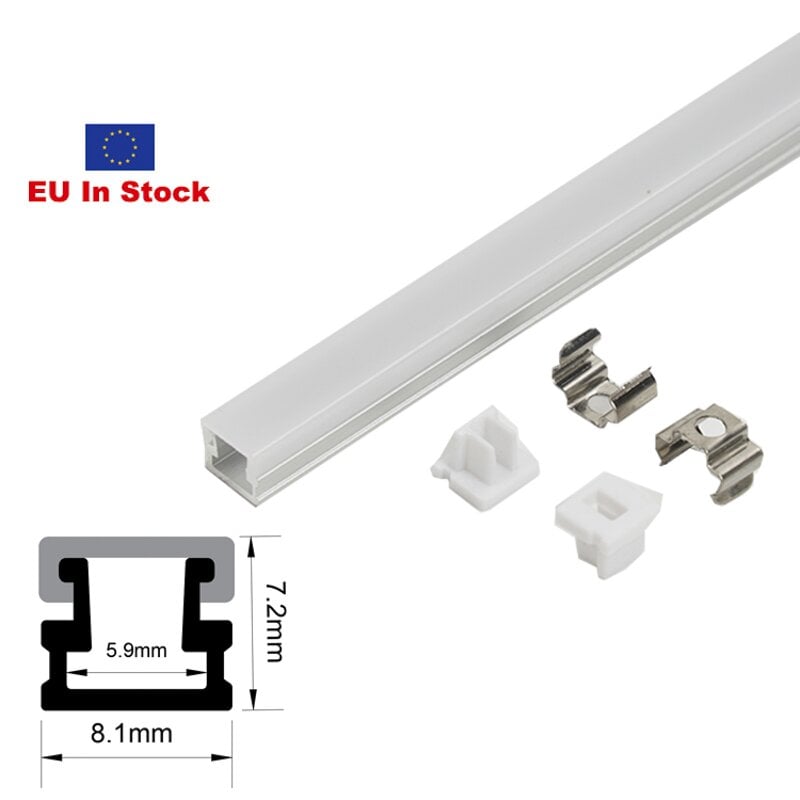
Aluminum profiles deliver significantly higher thermal conductivity than plastic alternatives—201–205 W/m·K versus just 0.1–0.3 W/m·K for common lighting plastics. This difference is decisive in real-world LED applications, where sustained operation can push component temperatures above 85°C. Aluminum’s crystalline lattice enables rapid, directional heat transfer away from the LED junction, preventing localized hotspots and thermal runaway. In contrast, plastic acts as a thermal insulator, trapping heat around sensitive electronics.
| Material | Thermal Conductivity (W/m·K) | Thermal Resistance (°C/W) |
|---|---|---|
| Aluminum Profile | 201–205 | 0.5–1.5 |
| Common Plastics | 0.1–0.3 | 10–25 |
| FR4 PCB Material | 0.25–0.4 | 8–15 |
This disparity directly impacts performance: under identical operating conditions, LEDs mounted in plastic housings run 30–40% hotter than those in aluminum profiles—a condition shown in 2023 thermal performance analyses to accelerate lumen depreciation by up to 45%.
Aluminum’s thermal efficiency directly extends LED service life—particularly against the industry-standard L70 benchmark (time to 70% lumen maintenance). Every 10°C reduction in junction temperature approximately doubles LED lifespan. With aluminum profiles, stable heat dissipation keeps junction temperatures reliably below 85°C, enabling L70 lifespans of 50,000–100,000 hours. Plastic housings, by contrast, often allow junction temperatures to exceed 100°C during continuous operation—cutting L70 life by more than half, per 2024 LED reliability studies.
Beyond longevity, aluminum ensures operational consistency. Its predictable thermal behavior maintains junction temperature within ±2°C across 24/7 duty cycles—eliminating the thermal cycling stress that triggers premature failure in plastic-housed units. This stability preserves color fidelity (CCT variation held within ±100K) and prevents the 15–20% lumen loss commonly seen in plastic-based systems after only 10,000 hours.
Aluminum’s natural oxide layer provides inherent, self-healing corrosion resistance—critical in coastal, high-humidity, or chemically aggressive settings like swimming facilities and food processing plants. Unlike plastics—which yellow, embrittle, and lose structural integrity under prolonged UV exposure—aluminum retains over 95% of its original tensile strength after 20 years of outdoor service. Accelerated weathering tests confirm plastic alternatives suffer 30–40% mechanical degradation within just 5–7 years. Aluminum’s zero moisture absorption and immunity to fungal growth further enhance reliability in hygienic or humid environments where material integrity directly affects safety and maintenance frequency.
Aluminum profiles resist deformation under sustained mechanical loads and extreme thermal swings—from –40°C to 80°C—without warping or stress cracking. This thermal resilience makes them ideal for industrial facilities with fluctuating ambient temperatures or transportation hubs subject to vibration. With a fatigue strength of 60–70 MPa at 10⁷ cycles and a modulus of elasticity of 69 GPa, aluminum outperforms engineering plastics like polycarbonate (2–3 GPa) in load-bearing capacity per unit weight. The result is slimmer, lighter profiles that maintain rigidity under wind loading, impact, or long-term compression—enabling more efficient, future-proof designs without compromising safety margins.
Although aluminum profiles carry a 30–50% higher upfront cost than plastic alternatives, their lifecycle economics are strongly favorable. Maintenance costs for aluminum systems are up to 70% lower over 15 years due to corrosion resistance and dimensional stability, according to the Building Materials Journal (2023). Plastic profiles typically require full replacement every 5–7 years due to UV degradation and embrittlement—adding recurring labor and material expenses. Meanwhile, aluminum’s superior thermal management sustains optimal LED junction temperatures, improving driver and diode efficiency and reducing annual energy consumption by 12–18%. These combined benefits typically offset aluminum’s initial premium within 5–7 years for commercial-scale deployments.
| Cost Factor | Aluminum Profiles | Plastic Profiles |
|---|---|---|
| Initial Cost | Higher (30–50%) | Lower |
| Replacement Interval | 15+ years | 5–7 years |
| Annual Maintenance | $50–$100 | $150–$300 |
| Energy Savings | 12–18% | 0% |
Aluminum stands out for circular economy compatibility: it is infinitely recyclable without loss of quality—retaining 95% of its original properties across repeated recycling loops. Recycling aluminum consumes only 5% of the energy required for primary production, compared to plastic’s heavy reliance on fossil feedstocks and energy-intensive reprocessing. Per the Aluminum Association (2023), architectural aluminum achieves recycling rates exceeding 70%, while plastic lighting profiles see less than 9% recovery—and even then, recycled plastic suffers significant property degradation. Crucially, the embodied energy of virgin aluminum is fully offset after just four recycling cycles, reinforcing its status as the environmentally responsible choice for sustainable, long-life infrastructure.
Aluminum profiles offer unmatched design versatility through precision extrusion—supporting custom cross-sections, integrated mounting features, and complex thermal geometries tailored to architectural or technical requirements. This adaptability enables sleek, load-optimized solutions across façades, modular interiors, and high-performance lighting systems—without sacrificing structural integrity. Aluminum’s exceptional strength-to-weight ratio allows for refined, minimalist profiles that would be impractical with heavier or weaker materials. Complemented by durable surface treatments—including anodizing for enhanced corrosion resistance and powder coating for broad aesthetic control—aluminum delivers consistent visual and functional performance indoors and out. For projects demanding precision engineering, decades-long durability, and cohesive design language, aluminum remains the benchmark material where off-the-shelf alternatives fall short.
1. Why is thermal conductivity important for LED applications?
Thermal conductivity is vital as it ensures heat generated by LEDs is efficiently dissipated. This prevents overheating, extends LED lifespan, and maintains optimal performance.
2. How does aluminum contribute to LED longevity?
Aluminum lowers junction temperatures, doubling LED lifespan for every 10°C decrease and ensuring consistency in performance and color accuracy over extended use.
3. Can aluminum profiles withstand outdoor conditions?
Yes, aluminum offers excellent UV resistance, corrosion tolerance, and reliability under high humidity and extreme temperatures, making it ideal for outdoor and demanding environments.
4. Are aluminum profiles more cost-effective than plastic?
While pricier upfront, aluminum profiles save costs long-term through lower maintenance, reduced replacement frequency, and improved energy efficiency, offsetting the initial investment.
5. Is aluminum environmentally sustainable?
Yes, aluminum is highly recyclable, retaining 95% of its properties, with energy-efficient production and reuse cycles, supporting a sustainable and circular economy.
 EN
EN