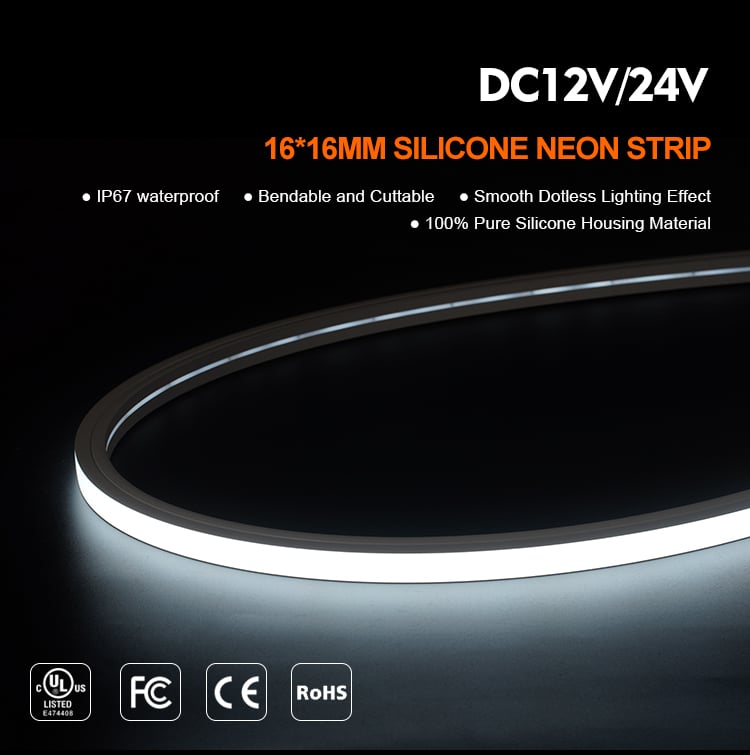
The design of an aluminum profile LED strip is fundamentally centered on efficient heat removal. Aluminum offers a thermal conductivity of approximately 201 W/m·K—nearly 700× higher than plastic or PVC enclosures, which typically measure below 0.3 W/m·K. This dramatic difference enables rapid conduction of heat away from the LED junction, preventing dangerous temperature buildup. In contrast, plastic traps heat, causing junction temperatures to rise unchecked—accelerating lumen depreciation and shortening lifespan by up to 50%. For linear lighting installations where reliability and longevity are non-negotiable, aluminum profiles are not optional accessories but essential thermal management components.
Thermal imaging provides direct, empirical validation of aluminum’s cooling advantage. Controlled testing shows LEDs mounted in aluminum profiles operate at junction temperatures 15–20°C lower (ΔT) than identical strips in plastic enclosures or without heatsinking. Since every 10°C reduction in junction temperature can double rated LED life—and also preserve luminous flux and color stability—this thermal margin delivers measurable performance gains. Installers can use thermal cameras to verify uniform heat distribution across the full run, confirming the absence of hot spots and validating that the profile functions as intended. This objective evidence supports specification decisions and assures long-term system integrity.
The internal geometry of an aluminum profile directly shapes optical efficiency. Precisely angled channels and highly reflective surfaces—achieved through anodizing or polished aluminum inserts—redirect laterally emitted light forward, increasing usable lumen output without added power draw. Compared to bare strips mounted on wood or plastic substrates, well-engineered aluminum channels improve directional light utilization by 20–30%. This gain reduces fixture count and energy demand while maintaining target illuminance. The enclosure further protects against dust accumulation and physical abrasion, preserving reflectivity over time. By pairing calibrated channel depth with purpose-selected diffusers, designers achieve either seamless wash lighting or focused task illumination—without compromising efficiency.
Hot spots—localized brightness peaks aligned with individual LEDs—undermine the visual quality of linear lighting. Aluminum profile LED strips resolve this through integrated, high-performance diffusion. Opal, frosted, or prismatic diffusers scatter point-source emissions into a continuous, homogeneous glow. Channel depth plays a critical role: deeper profiles provide more mixing volume, minimizing scalloping on adjacent surfaces; shallower profiles paired with high-diffusion covers suppress glare while sustaining uniformity—ideal for retail displays or architectural coves. This integrated approach eliminates the need for secondary diffusers, streamlining installation and preserving slim, elegant profiles. The result is professional-grade light quality, even at high power densities.
Material selection significantly influences long-term thermal behavior and durability. Anodized aluminum features a stable, porous oxide layer that raises surface emissivity to ~0.85—more than eight times higher than untreated extruded aluminum (~0.1). This enhanced radiative capacity complements aluminum’s inherent conductivity, lowering steady-state junction temperatures and improving overall thermal management. The oxide layer also delivers superior corrosion resistance against moisture, salt spray, and cleaning agents—critical for kitchens, bathrooms, or coastal installations. While extruded aluminum retains structural integrity, its untreated surface is vulnerable to oxidation and pitting in humid or chemically aggressive environments. Anodized finishes maintain thermal and aesthetic performance under extended UV exposure, making them the preferred choice for demanding interior and exterior applications.
Aluminum profiles deliver multifunctional value far beyond thermal control. The rigid extruded channel serves as a durable mechanical shield—protecting delicate PCBs and solder joints from impact, abrasion, and particulate contamination. This safeguard is especially vital in high-traffic zones, workshops, or commercial kitchens where accidental contact or debris exposure is likely. It also prevents dirt buildup on LEDs and optics, ensuring consistent light output and distribution over years of service.
IP ratings define real-world environmental resilience. While IP20 profiles meet basic indoor requirements, applications in wet or dusty locations—including bathrooms, covered patios, or outdoor facades—demand IP65 or higher. A properly sealed aluminum profile prevents water jet intrusion and particle ingress, directly extending system life and reducing maintenance frequency.
UV resilience is equally decisive for sun-exposed installations. Standard acrylic or PVC diffusers degrade under prolonged UV exposure—yellowing, cracking, and losing transmission. High-performance aluminum profiles address this with UV-stable materials: anodized finishes resist fading and chalking, while compatible diffusers made from polyurethane (TPU) or co-extruded polycarbonate retain clarity and optical performance. Together, these features ensure lasting light quality and appearance—making aluminum profiles suitable for exterior architecture, signage, and sunlit interiors alike.
Aluminum profiles are recommended because they offer 700× higher thermal conductivity than plastic, preventing heat buildup, prolonging LED lifespan, and maintaining brightness.
Diffusers scatter point-source LED emissions into a continuous, uniform glow, eliminate hot spots, and ensure high-quality, glare-free lighting.
Anodized aluminum profiles feature higher emissivity and superior corrosion resistance, making them better suited for long-term and demanding environments than untreated extruded aluminum.
Yes, aluminum LED profiles with IP65 or higher ratings and UV-stable materials are designed for outdoor and sun-exposed applications, offering protection against water, dust, and UV degradation.
Thermal imaging shows that LEDs in aluminum profiles operate at temperatures 15–20°C lower, proving their superior heat dissipation and validating their thermal design.
 EN
EN