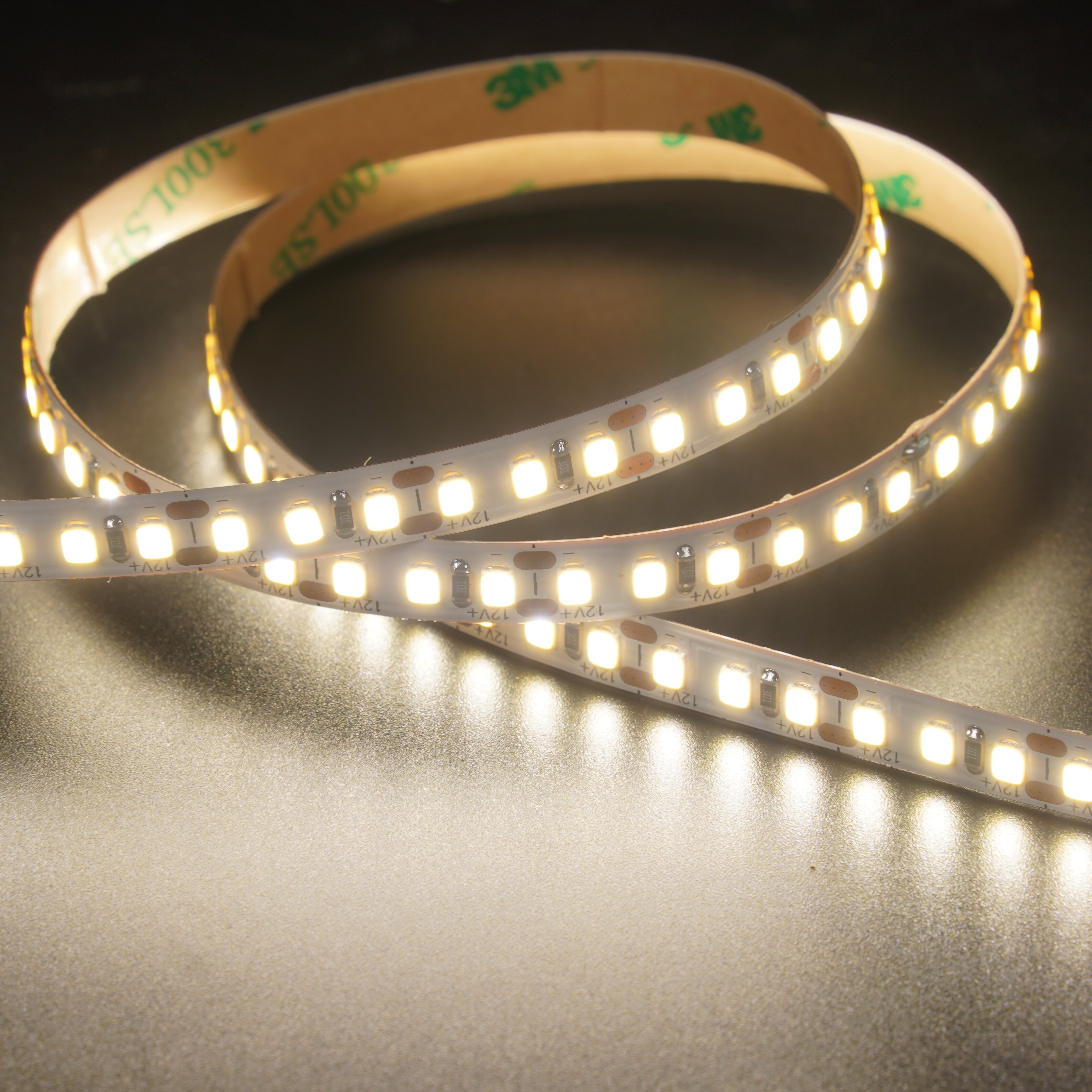
LED strips deliver significantly higher lumen density than traditional string lights—premium models reach up to 1,800 lumens per meter, compared to just 300–500 lumens for typical incandescent string lights. This intensity ensures vivid, consistent illumination that cuts through ambient light in crowded, high-energy party spaces. Crucially, high-output LEDs maintain color fidelity even at full brightness, avoiding the washed-out appearance common with overdriven string lights. Their directional emission focuses light precisely along bars, dance floors, or architectural features, whereas string lights scatter illumination unevenly—often leaving dim gaps between bulbs.
While most string lights offer only single-color or limited two-tone options, modern RGBIC LED strips leverage individually addressable diodes to produce 16.8 million colors. This enables true multicolor displays—like a rainbow gradient across a single strip—that are impossible with fixed-bulb strings. Programmable scenes transition smoothly through curated palettes (e.g., “Tropical Sunset” or “Disco Fever”), and smart strips store dozens of presets for instant ambiance shifts—no bulb swapping or physical filters required.
Advanced LED strips feature built-in microphones or app-based audio synchronization that converts live music into responsive lighting. Key modes include:
This transforms lighting into an active, immersive element of the celebration. In contrast, standard string lights lack integrated dynamic controls—any motion or rhythm effects require external hardware and offer minimal customization. Real-time smartphone adjustments let hosts or DJs adapt lighting to evolving music genres on the fly, a level of responsiveness physically unattainable with manually adjusted string lights.
LED strips with industrial-grade peel-and-stick backing install in seconds—directly onto walls, ceilings, furniture, or tent poles—without hooks, nails, or zip ties. Their lightweight, flexible design rolls compactly for effortless transport and storage. String lights, by comparison, rely on heavier mounting hardware that slows setup, limits placement options, and complicates takedown—especially in rented or temporary venues.
LED strips are engineered to be cut at factory-marked intervals, enabling precise fitting around corners, windows, curved surfaces, or irregular architectural elements. This eliminates unsightly excess wire or dark gaps. String lights come in rigid, non-adjustable lengths (e.g., 10, 20, or 30 feet) and cannot be shortened without disabling entire sections—forcing compromises like coiled surplus or inconsistent coverage. For parties in unconventional indoor layouts or multi-zone outdoor areas, this adaptability delivers cleaner, more professional results.
Smart LED strips support app-based scheduling—automatically activating as guests arrive—and one-tap switching between optimized scenes (e.g., “Dinner Warm,” “Dance Floor Pulse”). Voice integration with Alexa or Google Assistant enables hands-free control: “Dim lights to 40% and set to amber” executes instantly. Most string lights offer only basic on/off toggles or static color selection—no scheduling, no scene memory, and no voice compatibility—making them poorly suited for evolving party dynamics.
Bluetooth or Wi-Fi connectivity allows full control from anywhere in the venue—or even remotely—without line-of-sight constraints. IR remotes used with string lights require direct aiming and typically work only within 3–5 yards, a frequent point of failure in lively, crowded spaces. Additionally, Wi-Fi/Bluetooth strips support concurrent control from multiple devices, while IR systems rely on a single physical remote—a notable limitation when several hosts or guests want to influence the ambiance.
What are the advantages of LED strips over traditional string lights?
LED strips offer higher brightness, dynamic color flexibility, programmability, and easy installation. They also provide options like music synchronization and more precise coverage compared to string lights.
Can LED strips be customized for unique layouts?
Yes, LED strips can be cut to specific lengths at factory-marked intervals, ensuring a seamless fit for unconventional spaces or architectural features.
How are LED strips controlled?
LED strips are typically controlled via apps, voice commands through Alexa or Google Assistant, or Bluetooth/Wi-Fi connections, allowing remote and multi-device management.
Do LED strips consume more power than string lights?
No, despite their superior brightness and features, LED strips are energy-efficient and consume less power than traditional incandescent string lights.
Are music and motion sync features easy to use?
Yes, advanced LED strips with built-in microphones or app synchronization make it straightforward to integrate lighting effects with music in real time.
 EN
EN