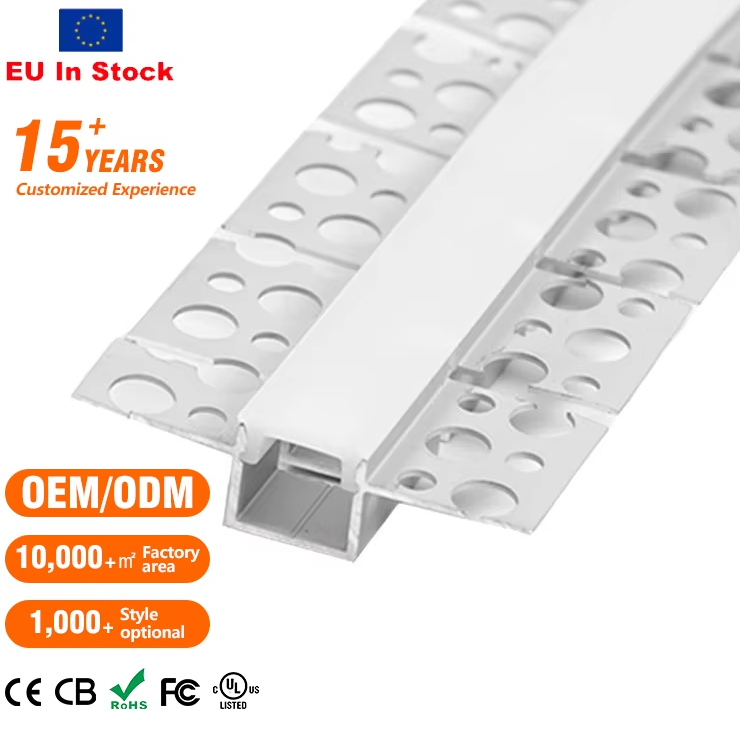
Engineers do not pick aluminum profiles by color swatch alone. They look at alloy, temper, wall thickness, cut tolerance, finish standard, and accessory compatibility. A profile that looks fine in a catalog can fail on site because a joiner is 0.5 mm off or a diffuser slot is too tight. The best specifiers treat the profile as a system: extrusion, diffuser, end cap, mounting clip, and driver tray all have to work together.
ASTM B221 provides a recognized baseline for aluminum extrusion chemistry and dimensions. 6063-T5 remains a common choice for linear lighting because it extrudes cleanly and moves heat well. But alloy alone does not guarantee a straight run. Die design, cooling, and stretching control determine whether a 3 meter piece stays within acceptable bow and twist.
Lightwolf started in Germany in 1991 and later set up a production base in Guangdong. That combination matters more than a label. German design oversight tends to focus on interface details: how a diffuser seats, how an end cap hides a screw, how a suspension kit aligns. Chinese production brings scale, tooling flexibility, and faster iteration on extrusion dies.
Engineers who specify aluminum profiles across multiple projects often care about consistency between batches. If a project starts with one finish and a later phase needs more pieces, color and geometry need to match. A single production base with in-house extrusion and finishing reduces the chance of a mismatch.
Not every project needs the same grade. A dry indoor cove may be fine with a standard anodized finish and a snap-in diffuser. A coastal walkway or a pool edge needs more attention to fasteners, gaskets, and drainage. The table below compares typical choices.
| Parameter | Standard indoor profile | Outdoor or wet-area profile | Why it matters |
|---|---|---|---|
| Alloy and temper | 6063-T5 | 6063-T5 or 6061-T6 | strength and heat path |
| Fasteners | zinc plated steel | stainless steel | galvanic corrosion |
| Gasket | EPDM or silicone | silicone | UV and compression set |
| Finish | anodized or powder coat | anodized plus sealed | salt and moisture |
| Drainage | not critical | weep holes, slope | standing water |
Qualanod and QUALICOAT labels give specifiers a recognizable benchmark for anodizing and coating quality. IES LM-80 and TM-21 data help with lumen maintenance projections, though those numbers assume the thermal conditions in the test setup.
A resort project in Southeast Asia had a linear lighting run along an exposed pool deck. The first installation used standard anodized aluminum profiles with zinc plated screws and EPDM gaskets. After one rainy season, the team found white corrosion around the end caps and water inside two driver compartments. The diffuser had also sagged in the middle of a 4 meter span.
The fix was not a single product swap. The team moved to 6063-T5 extrusions with a slightly deeper channel, stainless steel fasteners, silicone gaskets, and a small weep hole at the low end of each run. They also added a mid-span support clip. The next wet season passed without water ingress. The lesson: waterproofing is a system, not a gasket.
Engineers trust suppliers who answer questions quickly and ship what was ordered. That sounds basic, but site schedules are unforgiving. A missing end cap or a diffuser cut to the wrong length can stall a crew for days. Lightwolf’s factory in Guangdong runs a team of about 70 people with a full range of production equipment, which supports consistent extrusion, finishing, and accessory packing.
Another factor is engineering support. Some projects need help with profile selection, mounting details, or driver compartment layout. A supplier that can review a ceiling plan or a facade section before fabrication saves rework later. That kind of support is often what turns a one-time buyer into a repeat specifier.
The number 1000+ sounds like a badge, but it usually reflects repeat business. Engineers come back when a profile fits the first time, when finishes match across phases, and when a supplier understands that a linear run is a system. Lightwolf has been active in LED lighting since 1991 and now sells to over 50 countries. The company’s own production base in Guangdong helps keep aluminum profiles, LED strip, silicone neon, COB strip, and linear fixtures under one roof. For engineers, that means fewer handoffs, tighter tolerances, and a supply chain that is easier to plan around.
 EN
EN