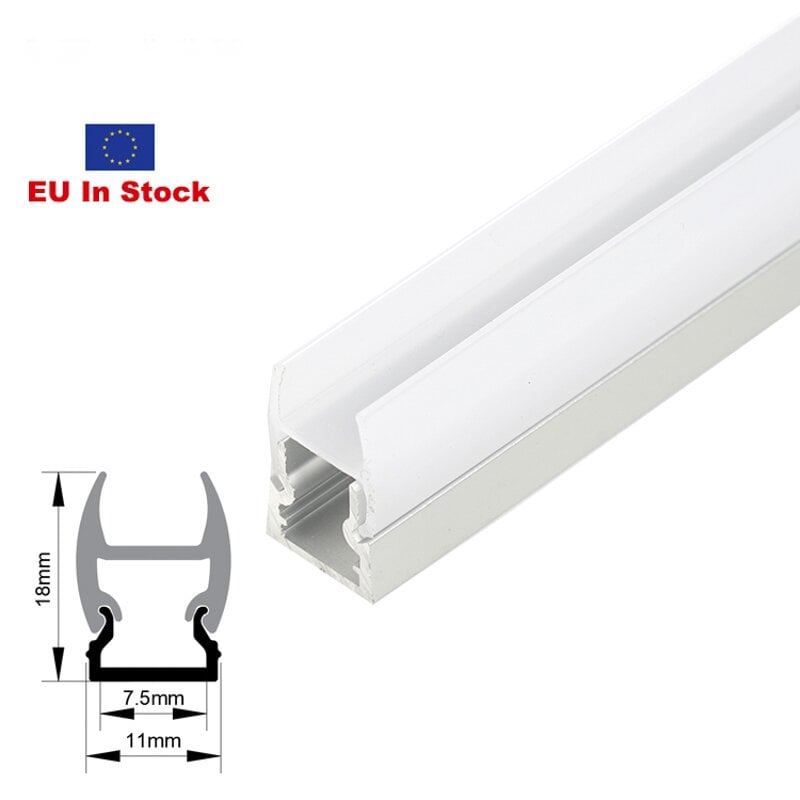
Proper thermal management is non-negotiable for commercial LED strip profiles. Aluminum extrusions serve as passive heatsinks, drawing heat away from LED chips and lowering junction temperatures by 15–30°C compared to unprofiled strips. As peer-reviewed studies confirm, every 10°C reduction in operating temperature doubles expected LED lifespan—directly mitigating lumen depreciation and chromatic shift, especially in continuous-use signage.
Outdoor installations require robust environmental protection. Type II/III anodized aluminum resists corrosion five times longer than untreated surfaces in salt-spray testing (per ASTM B117), while IP65+ rated polycarbonate diffusers seal the system against moisture, dust, and UV exposure. Together, they create a protected micro-environment for electronics—enabling coastal signage projects to maintain under 1% failure rates over five years.
Structural integrity in large-scale façades hinges on wind-load readiness. Aluminum profiles engineered for Category 4 hurricane zones must withstand dynamic pressures exceeding 150 Pa. Key design strategies include internal webbing (boosting torsional rigidity by 40%), continuous anchor points spaced at 300 mm intervals, and thermal-break gaskets that prevent metal fatigue at mounting interfaces. Compliance with ASCE 7-22 ensures resistance to vibration-induced solder joint failures—the leading cause of field defects in suspended architectural signage.
Polycarbonate (PC) and polymethyl methacrylate (PMMA) are the two dominant diffuser materials in commercial LED strip profiles—each optimized for distinct performance priorities. PMMA delivers superior light transmission (92% vs. PC’s 88%) and exceptional UV stability, preserving CRI >95 for over 50,000 hours in retail applications. Its resistance to yellowing ensures long-term color fidelity, critical for brand-consistent signage. While PC offers higher impact resistance, it requires proprietary anti-yellowing coatings to approach PMMA’s optical consistency. Both rely on micro-prismatic patterning for diffusion—but PMMA’s homogeneity reduces luminance variance to under 10%, supporting uniform visual fields.
Hot spots—localized brightness spikes exceeding 20% above ambient—undermine professional lighting quality. Precision-engineered LED strip profiles eliminate them through three integrated features: optical chambers lined with reflective material to redirect stray photons; matte-finish extrusions with micro-textured surfaces that scatter light across multiple angles; and calibrated LED density (120–150 LEDs/meter) that balances intensity without beam overlap. When paired with tapered diffuser edges, this system achieves uniformity ratings above 90%—a benchmark essential for backlit lobby signs and architectural façades where visual consistency reinforces brand authority.
In retail, space efficiency and visual clarity drive profile selection. Slim, low-profile LED strip profiles—typically under 15 mm deep—enable seamless integration into display joinery without obstructing sightlines or merchandising space. Their discreet form factor keeps branding front-and-center, while directional optics enhance product visibility without glare. This precision supports sales conversion by delivering cohesive, high-impact illumination that elevates product presentation.
Hospitality and façade projects demand profiles that harmonize aesthetics, durability, and installability. Custom anodized finishes—including matte black and bronze—allow exact color matching to surrounding architecture, while cold-bent or roll-formed curved extrusions accommodate organic building contours. Marine-grade aluminum paired with IP66-rated polycarbonate ensures resilience in high-moisture environments like coastal resorts or poolside lobbies. Crucially, integration-first design includes pre-routed cable channels and flangeless mounting systems—reducing installation time and complexity by 30% versus retrofit solutions—without compromising structural integrity or luminous uniformity across multi-story applications.
Proper thermal management is crucial because it lowers the operating temperature of LED chips, effectively doubling their expected lifespan by reducing lumen depreciation and avoiding chromatic shifts.
IP65+ ratings and anodized finishes help protect LED installations from moisture, dust, and UV exposure, significantly enhancing their durability and maintaining a failure rate of under 1% over five years in challenging environments.
Compliance with wind-load requirements, especially in Category 4 hurricane zones, ensures the structural integrity of large façades and reduces failures caused by pressure-induced vibrations and solder joint issues.
PMMA offers higher light transmission and greater UV stability, preventing yellowing and maintaining color consistency (CRI >95) for long periods, making it ideal for high-precision lighting applications.
 EN
EN