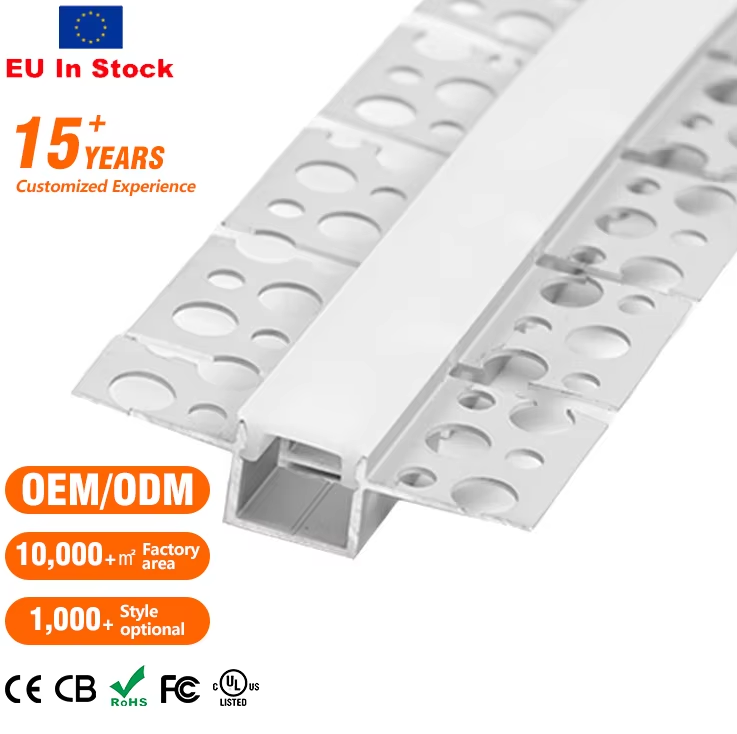
The thermal conductivity of 6063‑T5 aluminum—approximately 200 W/m·K—makes it the foundational material for passive heat management in LED strip profiles. This is more than four times higher than steel (50 W/m·K) and orders of magnitude greater than plastics, enabling rapid heat extraction from LED chips and suppressing critical junction temperature rise. The extrusion process allows precise, scalable fabrication of high-surface-area geometries—like finned channels—that maximize convective cooling efficiency. As confirmed by a 2021 U.S. Department of Energy study on LED thermal control, well-engineered aluminum heat sinks can reduce LED junction temperature by 20–30 °C compared to unmounted strips. Additionally, 6063‑T5 readily accepts anodization, raising surface emissivity from ~0.05 (bare aluminum) to ~0.8—a key enhancement for radiative heat loss. When mounted inside such a profile, the LED strip operates within a continuous, zero-maintenance passive cooling loop: no fans, no noise, no wear—and decades of reliable performance.
Thermal resistance (Rth), measured in °C/W, quantifies how effectively a profile transfers heat from the LED strip to ambient air. Lower Rth equals cooler junctions—and longer life. Independent 2022 testing demonstrated that optimizing wall thickness and adding fins can reduce Rth by over 60%. The table below shows typical performance for a 1-meter profile dissipating 10 W:
| Profile Design | Wall Thickness (mm) | Fin Design | Thermal Resistance (Rth) (°C/W) | Junction Temperature Rise Above Ambient (ΔTj) |
|---|---|---|---|---|
| Basic flat profile | 1.0 | None | 4.5 | 45 °C |
| Thick flat profile | 2.0 | None | 3.2 | 32 °C |
| Finned profile | 2.0 | Vertical fins | 1.8 | 18 °C |
Doubling wall thickness from 1.0 mm to 2.0 mm reduces Rth by ~30%, improving lateral heat spreading. Adding vertical fins further cuts Rth by ~40% by expanding convective surface area. In practice, upgrading from a basic flat profile to a finned 2.0 mm design lowers ΔTj by 27 °C—keeping LEDs well within safe operating limits and directly enabling the lifespan gains predicted by IES LM‑80 data.
Junction temperature is the dominant factor in LED longevity. Per the IES LM‑80 standard—which measures lumen maintenance under controlled conditions—LED degradation follows the Arrhenius rate law: chemical aging processes accelerate roughly twofold for every 10°C increase in junction temperature. Consequently, a 10°C reduction can double the time until light output drops to 70% of initial (L70). Mounting an LED strip inside a 6063‑T5 aluminum profile creates an effective passive heatsink: its large thermal mass and high conductivity draw heat away from copper traces and diode packages. Bench tests conducted in 2023 showed that integrating a standard 1.5 mm-wall 6063‑T5 profile reduced solder-point temperature by 15°C under identical drive current—extending L70 life from 30,000 to over 60,000 hours. Finned designs and thicker walls further improve thermal reservoir capacity and convective transfer—delivering consistent brightness and color stability without added complexity or cost.
Beyond thermal control, the LED strip profile delivers essential mechanical and environmental protection. Bare strips are highly vulnerable: exposed diodes and micro-solder joints risk damage from incidental contact, cleaning abrasion, or repeated flexing. A rigid aluminum housing paired with a snap-on diffuser forms a durable barrier that absorbs impact and distributes mechanical stress. In outdoor or humid settings, the profile also mitigates environmental threats. UV radiation rapidly degrades white LED encapsulants—causing yellowing and lumen loss—but polycarbonate or PMMA diffusers with UV-blocking additives filter harmful wavelengths while preserving optical clarity. Meanwhile, IP-rated enclosures (e.g., IP65) seal out moisture and dust, preventing oxidation of copper traces on the flexible PCB—a leading cause of intermittent failures and uneven output. By combining physical armoring with environmental isolation, the profile safeguards both electrical integrity and visual performance—ensuring reliability in demanding applications like under-cabinet lighting, walkways, and outdoor signage.
A high-performance LED strip profile leverages optical synergy—not just thermal engineering. A PC (polycarbonate) or PMMA (acrylic) diffuser evenly scatters light across its surface, eliminating hotspots and glare while maintaining >90% light transmission and excellent impact resistance. Complementing this, a polished aluminum reflector (>90% reflectivity) captures side-emitted photons that would otherwise be lost, redirecting them toward the target plane. This dual-action system improves effective light utilization by 20–30% versus bare strips—boosting perceived brightness, enhancing uniformity, and reducing the number of fixtures needed for equivalent illumination. The result is a smooth, flicker-free, professional-grade light line that sustains visual quality and lumen output over time.
A well-chosen LED strip profile balances thermal performance, optical control, and practical installation needs. Begin with application context: surface-mounted profiles suit under-cabinet or wall lighting; recessed variants enable flush integration into furniture or architecture; corner profiles accommodate 90° edges; and IP-rated waterproof models are essential for outdoor or damp environments. Next, verify dimensional compatibility—the profile width must fit the strip, and deeper channels improve diffusion and minimize visible LED dots. Diffuser choice shapes aesthetics: clear diffusers maximize output but may reveal individual emitters; frosted or opal options deliver seamless, uniform lines at a slight lumen cost. Mounting method affects durability—screw-mounted clips ensure long-term stability, whereas adhesive backing offers speed but risks delamination over time. Finally, consider beam control: internal reflectors or angled extrusions allow precise light shaping—from narrow task beams to wide ambient washes—ensuring the profile aligns with the functional and visual intent of the lighting design.
6063‑T5 aluminum offers excellent thermal conductivity (200 W/m·K) and is anodizable for improved surface emissivity, making it ideal for passive heat dissipation in LED strip profiles.
Thicker walls improve lateral heat spreading, reducing thermal resistance, while fins increase convective surface area, further lowering thermal resistance for better heat management.
High junction temperatures accelerate chemical aging, reducing LED lifespan. Every 10°C reduction in junction temperature can double lifespan, as per IES LM‑80 standards.
Profiles shield LED strips from physical damage, UV degradation, and moisture by offering mechanical protection and housing with UV-blocking diffusers and IP-rated enclosures.
Diffusers scatter light uniformly, while polished aluminum reflectors redirect side-emitted photons, enhancing brightness, uniformity, and light efficiency.
 EN
EN