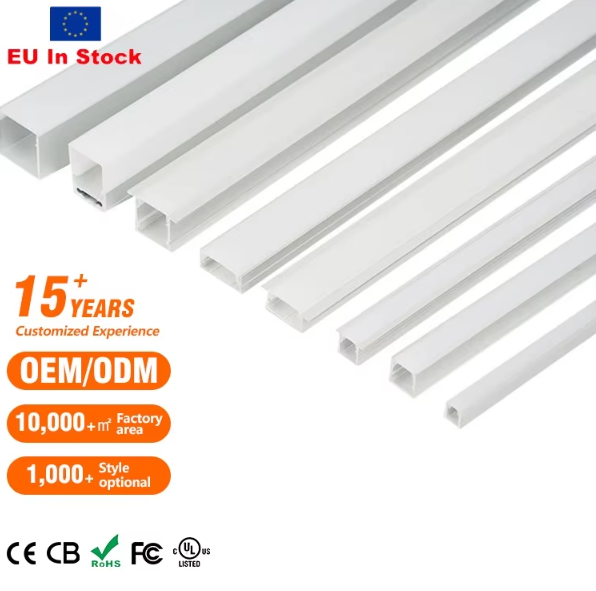
Outdoor linear lighting looks simple until the first hard rain. A channel that performs well in a showroom can fill with water, fog over, or corrode at the end caps after a few seasons. Waterproof aluminum profiles solve that gap, but the word waterproof covers a wide range of real conditions. Wind driven rain, salt fog, freeze thaw cycles, and UV exposure all attack different parts of the assembly. The extrusion is the frame, the heat sink, the mounting rail, and often the drainage path.
IEC 60529 defines the IP code, and IP65 or IP66 is often the first number a specifier sees. That rating comes from a laboratory test, not a lifetime prediction. A profile can pass IP66 with a fresh gasket and still leak after two summers of thermal cycling. The test does not fully account for gasket compression set, differential expansion, or water that enters through a cable gland and cannot drain.
| Sealing approach | Typical IP level | Strength | Common weak point |
|---|---|---|---|
| Silicone gasket, snap diffuser | IP65 to IP66 | serviceable, low cost | gasket creep, dirty seating surface |
| PU potting, sealed end caps | IP67 to IP68 | strong water block | hard to repair, thermal stress |
| Gasket plus breathable vent | IP66 to IP67 | handles pressure changes | vent clogging, wrong orientation |
| Fully potted with cable gland | IP68 | submerged use | cable bend radius, field assembly |
The table shows why a higher IP number is not automatically the better choice. A landscape wall wash that sees rain but drains freely may be better served by a serviceable gasket. A submerged fountain fixture needs a different architecture.
Material selection drives long term behavior. Extruded 6063-T5 remains common because it offers good extrusion quality and thermal conductivity, with ASTM B221 providing a recognized baseline. Anodizing adds a hard oxide layer, while powder coating can add color and thickness. Neither finish is a substitute for good joint design.
Hardware matters just as much. Zinc plated steel screws are a frequent failure point in coastal work. Stainless steel fasteners cost more, but they remove a galvanic couple that can open a seal. Silicone gaskets generally handle UV and temperature swings better than EPDM in this kind of application, though EPDM can work in milder climates when compression is controlled.
In a coastal boardwalk project, the installation team found that standard anodized profiles with zinc plated screws showed white corrosion and water ingress at the end caps after one rainy season. The team switched to 6063-T5 extrusions, stainless fasteners, silicone seals, and a small drain hole at the low end of each run. A follow up inspection after the next wet season showed dry driver compartments.
Outdoor profiles face two loads that indoor channels rarely see. The first is thermal cycling. Aluminum expands and contracts with temperature, and so does the diffuser. If the two materials are locked together too tightly, the seal can be pulled or compressed beyond its working range. Slotted mounting holes, floating end caps, and controlled gasket compression help the assembly move without opening a path for water.
The second load is UV. Sunlight degrades many polymers, and a diffuser that yellows or becomes brittle can lose its seal. Polycarbonate has good impact resistance but needs UV stabilization. Acrylic offers better clarity and UV resistance but can crack under stress. IES LM-80 and TM-21 data can help with LED lumen maintenance, but those projections assume the thermal and sealing conditions in the test setup.
Waterproofing is often a geometry problem. A profile mounted flat with no slope can hold a puddle against a gasket. A profile mounted with a slight fall lets water run off. End caps should sit above the low point, or a weep hole should be placed where water can escape.
Orient the channel so water cannot pool along the diffuser.
Place cable entries on the high side or inside a drip loop.
Use breathable vents where pressure differences are expected.
Keep gasket surfaces clean and free of metal chips during assembly.
A fixture that cannot be maintained will eventually be replaced, no matter how good the initial IP rating looks on paper.
The right waterproof aluminum profile depends on the environment, not on a single best answer. A covered soffit, an exposed facade, a salt spray zone, and a fountain edge each call for different gasket pressure, drainage, and material choices. Overbuilding every run with a fully potted IP68 channel adds cost, weight, and service difficulty. Underbuilding a coastal job with an indoor profile invites callbacks.
Lightwolf has worked in LED lighting since 1991 and runs a production base in Guangdong. That setup supports consistent extrusion, finishing, and accessory fit for outdoor linear projects.
 EN
EN