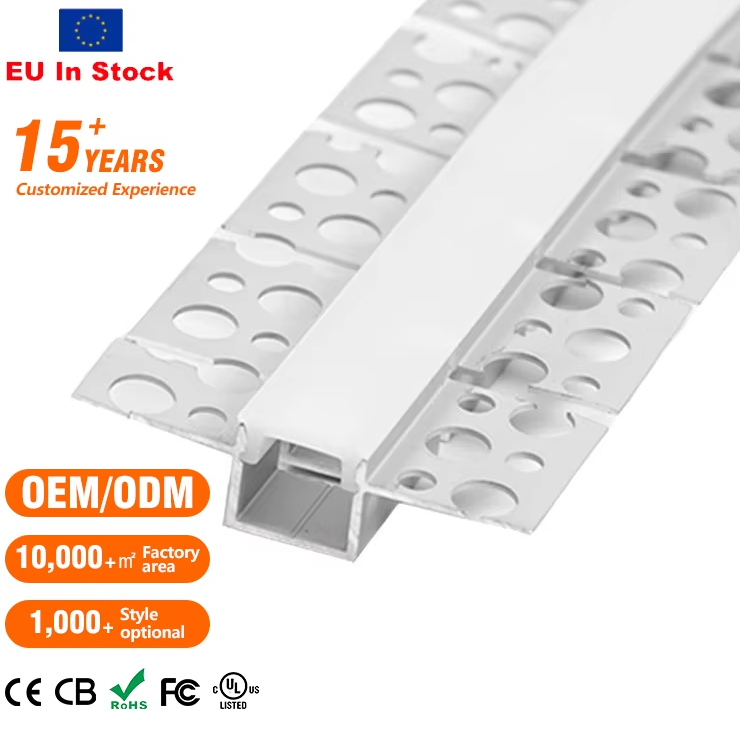
Linear lighting has moved from a fixture category to an architectural layer. In 2026, aluminum profiles are no longer a hidden commodity. They are the chassis, the heat path, the optical alignment rail, and often the visible trim. The profile decides how straight a 6 meter run looks, how evenly a diffuser sits, and how quickly heat leaves the LED board.
Extruded 6063-T5 remains the workhorse. ASTM B221 gives the dimensional and chemical basis, while the T5 temper balances strength and finish quality. A profile that twists by 1.5 mm over 3 meters may pass a bench test and still show a shadow line on a high ceiling. Design trends for 2026 reward profiles that solve structure, thermal management, and clean detailing at once.
Trimless and plaster-in details keep gaining ground in hospitality, retail, and high-end residential work. The goal is a continuous line of light with no visible frame. The profile becomes a plaster channel with a mud flange, a diffuser, and a separate LED tray. Installation sequence decides success.
The ceiling contractor sets the channel before drywall.
The lighting contractor pulls wiring through a dedicated raceway.
The finisher fills, sands, and paints around the flange.
The LED tray and diffuser go in after finishing.
In practice, drywall thickness, joint compound buildup, and ceiling deflection can close the optical aperture. A 2024 survey from a European lighting controls group found that rework on trimless linear jobs often traces back to missing coordination, not product failure. The profile can be perfect and still fail if the ceiling plane moves.
Higher output linear LEDs and smaller drivers push thermal design earlier. Aluminum alloy choice changes the heat path. The table below compares common materials used around linear fixtures.
| Material | Typical thermal conductivity | Extrusion behavior | Common role |
|---|---|---|---|
| 6063-T5 | about 200 W/m·K | excellent | long linear runs, visible trim |
| 6061-T6 | about 167 W/m·K | moderate | structural spans, brackets |
| Die-cast ADC12 | about 96 W/m·K | not extruded | end caps, driver housings |
Thermal conductivity is only one variable. Surface area, wall thickness, contact pressure, and thermal interface material matter just as much. IES LM-80 and TM-21 data help predict lumen maintenance, but those projections assume the LED board sees the thermal conditions used in testing.
In a retrofit at a chemical plant in southern China, the project team found that standard anodized profiles with zinc-plated steel screws failed salt-spray checks within months. Switching to 6063-T5 extrusions, stainless fasteners, and silicone gaskets solved the corrosion path, but it added 2 mm to the visible flange. Material selection is a system decision.
Matte black, warm bronze, brushed nickel, and natural anodized finishes are all part of the 2026 palette. Finish choice is not only visual. Powder coating can be 60 to 100 microns thick, which slightly insulates the profile. Anodizing is thinner and keeps the metallic look, but color consistency across batches depends on alloy chemistry and process control. Qualanod and QUALICOAT labels give specifiers a recognizable quality benchmark.
Geometry is moving in two directions at once. Some designs use micro flanges and 15 mm apertures to disappear into the ceiling. Others use deeper channels with asymmetric optics to wash a wall or graze a texture. Both approaches demand clean extrusion dies and tight cut lengths. A sharp internal radius can trap light and create a bright spot. A loose diffuser slot can rattle or sag.
Linear profiles are becoming infrastructure. Tunable white, daylight harvesting, emergency backup, and occupancy sensing all need space. The cleanest designs separate mains voltage, low voltage, and data into distinct chambers. That separation reduces noise, simplifies inspection, and makes future upgrades less destructive.
Zhaga Book 20 and similar interface efforts point toward modular LED boards and drivers that can be swapped without replacing the whole channel. In practical terms, a profile schedule should answer a few questions early:
Is there a continuous raceway for mains wiring?
Can drivers be accessed from below or from a remote enclosure?
Does the diffuser allow tool-free removal?
Are sensors mounted in a way that avoids shadowing?
Projects that skip these questions often end up with surface-mounted boxes, visible flex conduit, or compromised optics. Integrated channels cost more upfront. They also reduce the number of trades needed later.
A profile schedule is a manufacturing document, not a mood board. Before releasing it, check alloy, temper, wall thickness, cut tolerance, finish standard, diffuser material, and mounting method. Ask for a 1:1 sample of the longest run. Confirm that end caps, joiners, and suspension kits come from the same extrusion family. Mixed suppliers can create gaps that no amount of silicone will hide.
Supply chain matters too. Aluminum extrusion capacity, anodizing line availability, and freight lead times can move a project date. A brand with German design oversight and a factory in Guangdong can often balance quality control and flexible production. Lightwolf, for example, has been active in LED lighting since 1991 and now runs its own production base in Guangdong, which helps keep profile geometry, finishing, and accessory fit under one roof.
 EN
EN